Why Jaisalmer matters for sourcing

Jaisalmer Fort, the Golden City — built from the same yellow sandstone buyers source today.
The fort in the photo isn't just a pretty backdrop — it's the product catalogue. Every carved balcony, every jali screen, every golden wall is made from the local yellow sandstone, worked by artisan families who've been carving it for centuries. When you buy Jaisalmer stone, you're buying into that tradition.
The stone itself is distinctive: a warm golden-yellow sandstone, softer than granite but harder than you'd expect, with a glow that photographs beautifully and looks even better in person. It's been exported for decades — mostly for cladding, paving, and architectural pieces — but it remains a specialist product. You won't find Jaisalmer stone in every yard; you find it through people who know the quarries and the carvers.
One honest note: Jaisalmer is remote — right at the edge of the desert, near the Pakistan border. The supply chain is thin and personal. This is not a place to source blind. But with someone on the ground, the quality-to-price ratio is excellent.
What buyers actually source from Jaisalmer
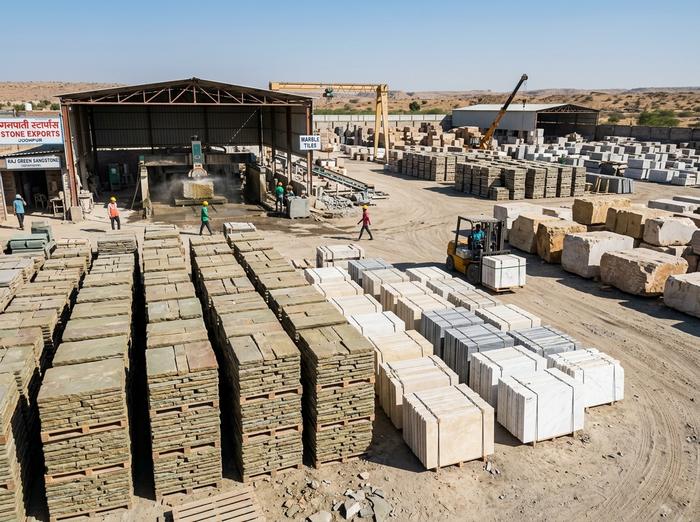
- Golden yellow sandstone slabs and tiles — the signature product. Flooring, cladding, paving in that unmistakable desert gold.
- Architectural carving — carved panels, brackets, columns, door surrounds in the Jaisalmer style. Made by hand, by carvers who learned from their fathers.
- Jali screens — pierced stone lattice screens, from simple geometric patterns to intricate floral designs. Stunning as room dividers, facades or garden features.
- Carved artefacts and décor — smaller pieces: lanterns, planters, fountains, decorative panels.
- Cobbles and setts — tumbled golden cobbles for driveways and landscaping.
How sourcing actually works here
Jaisalmer's stone trade is small-scale and relationship-driven. Here's the reality:
The quarries are local and limited. Jaisalmer yellow sandstone comes from quarries around the town. Output is modest compared to the big sandstone belts — this isn't a high-volume commodity stone. That's fine for architectural projects and feature orders, but if you need 50 containers of identical pavers, we'll tell you honestly whether Jaisalmer can deliver or whether you should look at Barmer for volume.
Carving is the real value. The stone itself is lovely, but the carving is what makes Jaisalmer special. The carvers work by hand — chisels, not CNC, for the good stuff. That means every piece is slightly unique, lead times are real (carving can't be rushed), and the quality depends entirely on which carver gets your order. We know the workshops and we know who's actually good.
Jali screens need engineering sense. A beautiful jali design that's too thin will crack in transit or under its own weight. We check the design against practical limits — minimum thickness for the span, proper framing, sensible packing. Art that arrives in pieces isn't art.
Everything funnels through Jodhpur. Jaisalmer stone travels by road to Jodhpur, then joins the standard export route via the ICD to Mundra port. We coordinate this as one chain — quarry to carver to container.
Where it goes wrong
Soft stone in the wrong application
Jaisalmer sandstone is a medium-soft stone. It's beautiful for cladding, carving and light paving — but it's not the right choice for heavy-traffic commercial flooring or freeze-thaw climates without proper sealing. We've seen buyers spec it for applications where a harder stone was needed, then blame the stone. We'll tell you honestly if your application needs something tougher.
Carving depth inconsistency
Hand carving varies. On a single panel it's character; across 50 panels for a hotel facade, inconsistent depth looks like a mistake. We check carved pieces against the approved sample — depth, detail sharpness, and finish — across the whole batch.
Breakage in transit
Carved stone and jali screens are fragile by nature. Thin sections snap, delicate tracery crumbles. This is almost always a packing failure, not a stone failure. We supervise packing personally: custom crates, foam separation, proper bracing. Stone that travels 10,000 km needs better than hope.
"Jaisalmer" stone that isn't
The golden colour is the selling point, so other yellow sandstones sometimes get sold under the Jaisalmer name. The visual difference is subtle but the price difference isn't. We verify the quarry source.
What happened to a buyer we now work with: A boutique hotel developer in Spain ordered carved sandstone panels and jali screens for a new property — a big, beautiful order. The carving was gorgeous. But the jali screens arrived with nearly a third cracked: they'd been packed flat, stacked, with nothing between them. Thousands of euros of artisan work, destroyed by bad packing.
Now we design the packing before the carving starts — crate dimensions, bracing points, separation materials. The carvers know the packing plan before they pick up a chisel. Not a single cracked screen since.
Our quality checks, specifically
- Quarry verification: genuine Jaisalmer yellow sandstone, confirmed at source.
- Carving quality: checked against approved samples — depth, detail, consistency across the batch. We photograph pieces individually for carved orders.
- Jali structural check: minimum thickness for the design, stress points, sensible engineering. If a design won't survive shipping, we say so before it's carved.
- Finish check: honed, natural, or polished — consistent across all pieces.
- Packing supervision: custom crates for carved pieces, individual wrapping for jali screens, proper bracing. We don't leave this to chance.
- Loading: supervised container loading with seal photos.
Local market insights worth knowing
Hand carving takes the time it takes. A skilled carver produces a certain amount per day, and no amount of money makes chisels move faster without quality suffering. For carved orders, build in realistic timelines — typically 8–14 weeks depending on complexity. Rush a carver and you'll get rush quality.
The best carvers don't have websites. The master carvers of Jaisalmer work through relationships and reputation, not Google. Finding them requires being there and knowing who to ask. This is one of the places where our local presence matters most.
Golden sandstone darkens when sealed. Worth knowing for your customers: most sealers deepen the golden tone. Make sure your sample approvals account for the sealed finish, not just the raw stone — otherwise the installed result surprises everyone.
Combine with Jodhpur orders. Jaisalmer stone and Jodhpur furniture or Barmer paving combine well in shared containers. We coordinate multi-city loads regularly — it cuts your freight cost significantly.
What we actually do for you in Jaisalmer
- Quarry and carver verification — real stone, real artisans, real capacity.
- Design review — we check your drawings against what's carveable and shippable before work starts.
- In-process checks at the carving workshop during production.
- Packing design and supervision — crates planned before carving begins.
- Pre-dispatch inspection and supervised container loading.
We're a sourcing and QC consultancy based in Jodhpur — not a manufacturer, not a trader. We don't take money from quarries or carvers. Our fee comes from you: 5–10% of the order value, or a $1,500–$3,000 monthly retainer if you're buying regularly. Quoted in writing, before we start.
Questions buyers ask us about Jaisalmer
Is Jaisalmer sandstone suitable for exterior use in cold climates?
With caveats. It's a medium-soft sandstone — fine for cladding and light paving in temperate climates, but in freeze-thaw zones it needs proper sealing and correct installation (good drainage, no water pooling). We'll give you an honest assessment for your specific climate and application.
Can you replicate a specific jali design I have?
Usually yes — send us the drawing or photo. Our carvers work from CAD drawings or hand sketches. We'll confirm feasibility and quote before anything starts. Very fine tracery may need design adjustments for structural reasons; we'll explain why.
How long does carved stone take?
Simple carved panels: 6–8 weeks. Complex jali screens or deep architectural carving: 10–14 weeks. These are hand-work timelines — anyone promising faster is either using machines (fine, if that's what you want) or cutting corners.
What's the minimum order for carved pieces?
Carvers will take small orders — even single pieces for samples. For production, most workshops want enough to keep their carvers busy for a few weeks. We'll match your order size to the right workshop.
Can you handle the export packing for fragile carved stone?
This is specifically what we're good at. Custom wooden crates, individual wrapping, bracing designed around each piece. We plan the packing before carving starts, and we supervise it personally. Fragile stone is our bread and butter.