Why Kishangarh matters for sourcing
Picture this: mile after mile of marble yards, the air white with stone dust, gangsaws screaming as they slice through massive blocks. That's Kishangarh — a small Rajasthan town that became the nerve centre of India's stone trade. Blocks arrive here from quarries all over India (and imported from Italy, Turkey, Brazil), get cut into slabs, and ship out to the world.
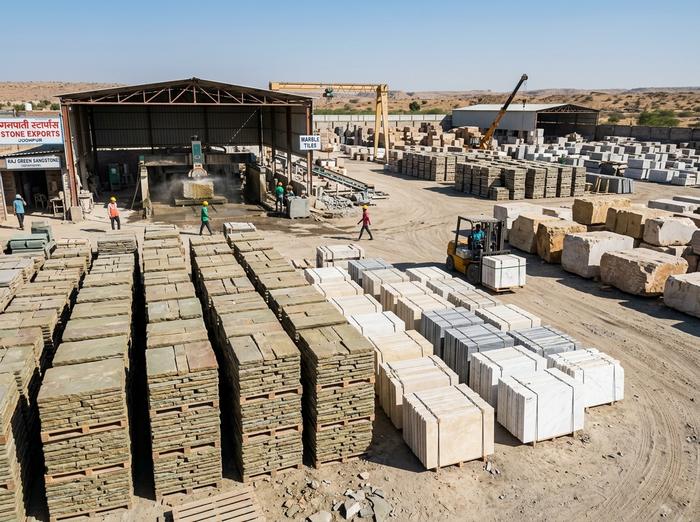
A Kishangarh stone yard — blocks in, slabs out. This is where India's marble trade happens.
Here's what most foreign buyers don't realise: Kishangarh is a processing and trading hub, not a quarry town. The marble doesn't come from under Kishangarh — it comes here to be cut. That means you're usually dealing with processors and traders, not quarry owners. Nothing wrong with that, but it changes what you need to check. You're not verifying a mine; you're verifying cutting quality, honest grading and fair pricing.
And the pricing games here are legendary. The same slab can have three different prices depending on who's asking and how the light hits it.
What buyers actually source from Kishangarh
- Marble slabs — Indian marble (Makrana white, green marble, Rainforest, Fantasy Brown) plus imported blocks cut here: Italian-style whites, Turkish beiges, Brazilian exotics.
- Granite slabs and tiles — South Indian granites processed in Kishangarh's gangsaw units: absolute black, Kashmir white, red and blue varieties.
- Cut-to-size tiles and pavers — calibrated tiles for flooring, wall cladding, countertops. Cut to your exact dimensions.
- Marble handicrafts and artefacts — smaller units making carved pieces, inlay work, decorative items.
How sourcing actually works here
Stone buying in Kishangarh follows its own logic. Here's the real process:
Slab selection is everything. With natural stone, no two slabs are identical. Serious buyers (or their agents — us) physically walk the yard and select specific slab numbers. We photograph each selected slab, note the bundle number, and that selection becomes part of the contract. If you let the supplier "select equivalent slabs," you'll get whatever they want to move.
Then the cutting. Blocks go through gangsaws — giant frames with dozens of blades cutting multiple slabs at once. The key variables: blade quality (affects surface finish), cutting speed (too fast = wavy slabs), and calibration (are your 20mm slabs actually 20mm?). We check slab thickness with calipers across multiple points. Variation over 1.5mm on calibrated tiles is a problem.
Then resin and filling. Here's where honesty matters most. Natural stone has cracks, pits and fissures. Legitimate processors fill these with resin — that's standard industry practice. The question is whether they tell you. We check slabs with raking light (light at a low angle) which reveals every fill, patch and repair. Then we make sure the grade and price reflect reality.
Then packing. Stone is heavy and unforgiving. Slabs travel in wooden A-frames or crates, tiles in ISPM-15 fumigated wooden boxes. Bad packing = broken corners = angry customers. We supervise the packing and the container loading.
Where it goes wrong
Resin-filled cracks sold as "natural"
The classic. A slab looks flawless in the yard photo. It arrives, you polish it on site, and the resin fill shows as a dull patch — or worse, the crack opens up. Some filling is normal. What's not normal is charging premium "first quality" prices for heavily repaired stone. We grade honestly and negotiate the price to match.
Thickness roulette
You ordered 20mm calibrated. You got 17mm in the middle and 22mm at the edges. Uneven thickness means lippage on the installed floor — and a furious tiler. We caliper-check random slabs from every bundle.
The great name game
"Italian marble" that's actually Indian. "Makrana" that's actually from Morwad. "Absolute Black" that's actually a different black granite. Names carry price premiums, so names get... stretched. We verify the actual quarry source before you pay quarry-source prices.
Epoxy that yellows
Cheap resin used for filling yellows within months, especially in sunlight. Your white marble develops yellow veins that weren't in the sample. We ask what resin the processor uses, and for exterior or sun-exposed applications, we push for UV-stable epoxy.
What happened to a buyer we now work with: A distributor in the US ordered three containers of "premium white marble" slabs from a Kishangarh trader. The yard photos looked stunning. When the containers arrived, about a third of the slabs had extensive resin filling that was invisible in the photos but obvious once polished. He'd paid first-quality prices for second-quality stone.
Now we select his slabs in person, photograph every bundle number, and check with raking light before anything gets packed. His last six containers have matched the grade he paid for.
Our quality checks, specifically
- Slab selection: we walk the yard, select specific slab/bundle numbers, photograph each one. The selection list goes into the purchase terms.
- Raking light inspection: low-angle light across every selected slab to reveal fills, cracks, patches and repairs the yard lighting hides.
- Thickness calibration: digital calipers on multiple points per slab. We reject bundles outside the agreed tolerance.
- Shade matching: we check that slabs within a bundle actually belong together. Mixed bundles are the fastest way to a ruined floor.
- Packing supervision: A-frames for slabs, fumigated crates for tiles, proper dunnage. We photograph the loading and the container seal.
Local market insights worth knowing
Prices are negotiable — always. The first quote in Kishangarh is never the real price. It's the opening bid. The real price depends on volume, payment terms, the season, and whether the trader thinks you'll be back. We negotiate in the local idiom, which gets better numbers than email haggling from abroad.
Monsoon affects supply. Quarry output drops during the rains (July–September) — blocks get harder to move, prices firm up. If you're buying quarry-direct material, factor this in.
Don't buy stone you've never seen. This sounds obvious, but it happens constantly — buyers approving slabs from phone photos. Phone cameras lie about stone: they flatten depth, warm up colours, and hide every flaw. Either come yourself or send us. There's no third option that works.
Payment terms matter. The standard here is a deposit (20–30%) with balance against documents. Never pay 100% upfront to a trader you've never met. We'll structure the payment so your money is protected at each stage.
What we actually do for you in Kishangarh
- Yard verification: we check the processor is real — gangsaws on site, workers, order books — not just a trading desk.
- Slab selection and grading: in-person selection, honest grading, price negotiated to match the actual quality.
- Production monitoring: we check cutting quality and calibration during processing, not just at the end.
- Pre-dispatch inspection: final check of selected slabs, packing supervision, container loading with seal photos.
We're a sourcing and QC consultancy based in Jodhpur — not a manufacturer, not a trader. We don't take money from factories. Our fee comes from you: 5–10% of the order value, or a $1,500–$3,000 monthly retainer if you're buying regularly. Quoted in writing, before we start.
Questions buyers ask us about Kishangarh
Can I buy directly from the quarry instead?
Sometimes, but quarries sell blocks — huge, uncut, tonnes each. Unless you're buying 50+ blocks or you own a gangsaw, you need a processor. What we do is make sure your processor is honest about what the block cost and what the cutting should cost. The margin should be fair, not fantasy.
How do I know the marble is really from the quarry claimed?
For premium stones like Makrana, we verify through the quarry paperwork and our knowledge of what each quarry actually produces. If someone offers you "Makrana white" at half the going rate, it's not Makrana. We'll tell you straight.
What's a realistic price for good quality marble slabs?
It varies wildly by stone — Indian whites from a few dollars per square foot, exotics much more. Rather than quoting blind, tell us which stone and what grade, and we'll get you real yard prices. The range is so wide that generic numbers would mislead you.
How long does an order take?
If the slabs are in stock at the yard: 2–3 weeks for selection, cutting to size, packing and dispatch. If blocks need to be cut fresh: 4–6 weeks. Imported blocks (Italian/Turkish) add their own timeline. We'll confirm against actual yard stock, not promises.
Do you handle the export paperwork?
We make sure it's right — invoice, packing list, fumigation certificates for the wooden packing, and quarry/origin documentation where needed. Stone is heavy cargo; the paperwork has to match the weight exactly or customs will hold it.