Why Makrana is special — and why that matters
Let's start with the history, because it explains the money. In the 1600s, marble from Makrana's quarries travelled hundreds of kilometres to Agra to become the Taj Mahal. That white calcite marble — bright, dense, slightly translucent — became the most famous building stone on earth.
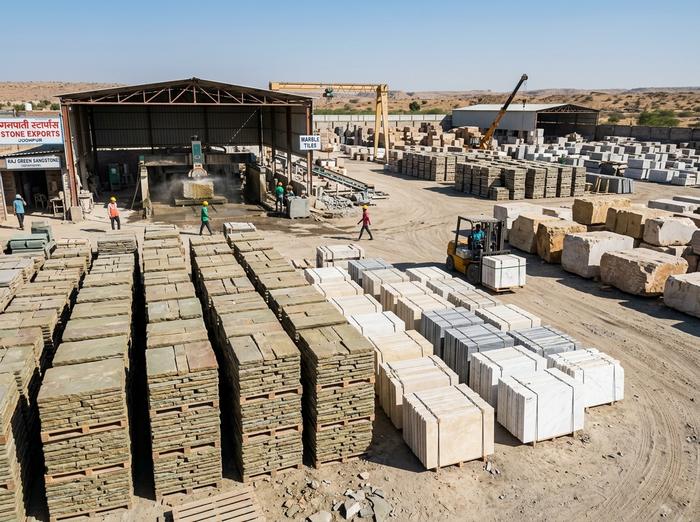
Makrana's marble yards — where the Taj Mahal's stone was born. The name carries a premium; verify before you pay it.
Today, "Makrana" is a brand as much as a place. And like every valuable brand, it gets counterfeited. All over India, ordinary white marble gets sold as "Makrana" to buyers who can't tell the difference — at Makrana prices. The premium is real: genuine Makrana white costs significantly more than generic white marble. So the incentive to fake it is enormous.
Here's the honest truth: most "Makrana marble" sold internationally isn't from Makrana's historic quarries. Some of it is decent marble from nearby areas. Some of it isn't decent at all. Our job is to make sure you know exactly what you're buying — and pay accordingly.
What buyers actually source from Makrana
- Makrana white marble slabs — the classic: bright white calcite with light grey or golden veining. For flooring, wall cladding, countertops, and prestige projects.
- Makrana marble tiles — cut-to-size, calibrated tiles for flooring and bathrooms.
- Carved marble artefacts — the town has generations of stone carvers: jaali screens, fountains, temple-style carvings, decorative pieces.
- Marble handicrafts — smaller items: coasters, trays, candle holders, inlay boxes.
How sourcing actually works here
Makrana is a quarry town, not a processing hub like Kishangarh. That changes the game.
The quarries. The historic Makrana quarries are controlled — mining leases, government regulation, limited new extraction. Genuine Makrana marble comes from a defined set of quarries, and output is finite. This is why the real stuff costs what it costs, and why anyone offering it cheap should make you suspicious.
Quarry vs. trader. Most foreign buyers end up dealing with traders or processors in Makrana town, not the quarry leaseholders directly. That's normal. What's not normal is a trader who can't tell you which quarry the block came from. We ask. We check the quarry documentation. If the paperwork doesn't exist, the "Makrana" label doesn't either.
Selection. With white marble, the enemy is variation you didn't agree to — grey patches, golden veins where you wanted pure white, or dull areas that won't polish. We select slabs in person under natural light (yard floodlights lie), photograph each one, and lock the selection into the purchase terms.
Processing. Much of Makrana's marble gets cut in Kishangarh's bigger gangsaw units — the two towns work as a pair. We coordinate across both: quarry verification in Makrana, processing supervision in Kishangarh.
Where it goes wrong
The name game (the big one)
This deserves its own heading because it's the single biggest issue in Makrana sourcing. Marble from Morwad, Abu Road, or other white-marble areas gets sold as "Makrana" every single day. Some of it's perfectly good marble — just not Makrana, and not worth Makrana money. We verify quarry origin through documentation and our knowledge of what each quarry's stone actually looks like. The visual differences are subtle but real: Makrana calcite has a particular brightness and crystalline structure that nearby dolomitic marbles don't match.
Dull patches that won't polish
White marble should take a mirror polish. Some blocks have softer zones that stay hazy no matter how much they're polished. In the yard, under dust and water spray, everything looks fine. We check polish quality on sample cuts before committing to full slab quantities.
Golden veining surprises
Some Makrana white has beautiful golden or grey veining — and some buyers love it. But if you ordered pure white and got veined, that's a problem. Veining varies block to block, so this comes back to in-person slab selection. Photos don't capture it reliably.
Cracks filled and forgotten
Like all natural stone, Makrana marble gets resin-filled. Standard practice — but the fill should be disclosed and priced accordingly. We check with raking light and make sure the grade matches the price.
What happened to a buyer we now work with: An architect in Dubai specified genuine Makrana marble for a luxury villa project — the client specifically wanted "the Taj Mahal stone." The supplier delivered white marble at full Makrana prices. Our check found it was good-quality marble, but from a different quarry belt entirely — worth about 40% less than what they'd paid.
We helped them renegotiate, and now we verify quarry origin on every Makrana order before a single rupee moves. The name is worth money. Make sure you're buying the name, not just the story.
Our quality checks, specifically
- Quarry verification: we confirm the actual quarry source through documentation and visual identification. If the paperwork doesn't support the "Makrana" claim, we say so — plainly.
- Slab selection: in-person, natural light, every slab photographed and numbered. No "equivalent" substitutions.
- Polish test: sample cuts polished to check for dull zones before you commit to the full quantity.
- Raking light check: reveals fills, cracks and repairs that yard lighting hides.
- Thickness and calibration: caliper-checked for cut-to-size orders.
- Packing: A-frames, proper dunnage, fumigated crates — supervised loading with seal photos.
Local market insights worth knowing
Genuine Makrana is finite. The historic quarries aren't getting bigger. Prices for the real thing have a floor that doesn't move much — if someone's "Makrana" is dramatically cheaper than everyone else's, it's not Makrana. This isn't cynicism; it's geology.
The carvers are the hidden gem. Makrana's stone carvers are extraordinary — generations of skill. If you're buying carved pieces (jaali, fountains, decorative work), the craftsmanship here is genuinely world-class. Just make sure the design drawings are precise; "artistic interpretation" is not what you want on a paid order.
Combine with Kishangarh. Most buyers do Makrana selection and Kishangarh processing as one coordinated purchase. We handle both ends — it's a 2-hour drive between the towns, and we make it regularly.
Ask for the quarry name, not just "Makrana." Serious sellers will tell you which quarry — Doongri, Ulodi, Devi, and others each have their character. A seller who can't name the quarry probably doesn't know where the stone came from.
What we actually do for you in Makrana
- Quarry and supplier verification: real quarry, real paperwork, real stone.
- In-person slab selection with photography and locked-in terms.
- Processing supervision coordinated with Kishangarh cutting units.
- Pre-dispatch inspection and supervised container loading.
We're a sourcing and QC consultancy based in Jodhpur — not a manufacturer, not a trader. We don't take money from quarries or traders. Our fee comes from you: 5–10% of the order value, or a $1,500–$3,000 monthly retainer if you're buying regularly. Quoted in writing, before we start.
Questions buyers ask us about Makrana
How can I be sure it's really Makrana marble?
Quarry documentation plus visual verification by someone who knows the stone. Makrana calcite has specific characteristics — brightness, crystal structure, veining patterns. We check both the paperwork and the stone itself. If either doesn't add up, we tell you.
Is Makrana marble worth the premium over other white marbles?
Depends on your project. For prestige work where the name matters — yes, clients pay for "the Taj Mahal stone." For a standard white floor where nobody asks the quarry name — a good Morwad or Abu Road marble at 40% less might be smarter. We'll give you the honest comparison.
Can you get large slabs?
Up to gangsaw size — typically around 8x4 feet, sometimes larger for special blocks. Tell us your dimensions and we'll confirm against actual block availability. Don't design around 10-foot slabs unless we've confirmed the block exists.
How long does an order take?
Stock slabs: 2–3 weeks for selection, cutting, packing. Fresh quarry blocks: 5–8 weeks including cutting time. Carved pieces: 8–12 weeks depending on complexity. We'll confirm against reality, not optimism.
Do you handle both Makrana and Kishangarh in one trip?
Yes — that's how most stone orders work. Quarry verification in Makrana, processing in Kishangarh, one coordinated inspection and loading plan. We've been doing this run for years.