Why Kota matters for stone buyers
If you're buying limestone flooring or paving from India, you've probably heard of Kota. This city in Rajasthan sits on one of the world's largest limestone deposits, and the stone that comes out of here — the blue-grey and brown varieties — ends up on floors across Europe, the Middle East, and America. It's hard-wearing, it's affordable, and it takes a polish that rivals stone costing three times more.
Here's the catch: Kota stone is a natural product cut in hundreds of small processing units around the city. Quality varies wildly from yard to yard. One supplier's "calibrated 20mm" is another's "roughly 20mm, give or take." If nobody checks on the ground, you find out the truth when your tiler calls from site.

Jagmandir Palace on Kishore Sagar lake — Kota's landmark, in the heart of Rajasthan's stone country. (Photo: Wikimedia Commons)
What to source from Kota
- Blue Kota limestone — the classic blue-grey, for flooring, wall cladding, and outdoor paving
- Brown Kota limestone — warmer tones, popular for patios and garden paving
- Calibrated tiles — machine-cut to exact thickness (18mm, 20mm, 25mm) for easy laying
- Tumbled and honed finishes — for that aged, soft look in residential projects
- Cobbles and pavers — for driveways and heavy-traffic outdoor areas
Most serious buyers order calibrated tiles. Uncalibrated (hand-dressed) stone is cheaper but the thickness variation makes laying slow and expensive on your end. Do the maths: the saving on the stone usually gets eaten by extra labour.
Where Kota orders go wrong
Thickness drift. This is the number one complaint. You approve 20mm calibrated, and the container arrives with tiles ranging from 17mm to 24mm. It happens when the processing unit's calibration machine is worn, or when they mix batches from different runs. Your tiler can't lay uneven tiles without lippage — and relaying costs you, not the supplier.
Shade variation. Kota stone has natural colour variation, and that's fine — up to a point. The problem is when one container mixes stone from three different quarry faces and the floor looks patchy. A dry-lay check before packing catches this. Almost nobody does it unless someone's standing there.
Edge chipping. Tiles get stacked, strapped, and loaded fast. If the packing crew skips edge protectors, you lose 5–10% of the shipment to chipped corners. On a full container, that's real money.
A German distributor came to us after two containers of "calibrated" Kota arrived with thickness all over the place. His laying crew in Munich spent three extra weeks on the job. The rework cost more than our inspection fee for a year.
What we actually do for you in Kota
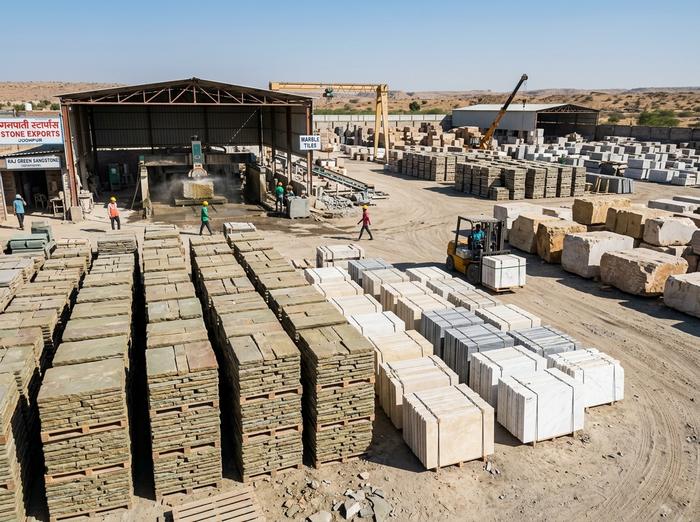
- Yard visits before you commit. We go to the processing unit, check the calibration machinery, look at current stock, and verify they're cutting what they claim.
- Thickness checks during production. We pull tiles from the line and measure with digital callipers. If the calibration is drifting, we flag it before the whole batch is cut wrong.
- Dry-lay shade matching. Before packing, we lay out tiles from different pallets side by side. If the shades don't blend, we sort or reject.
- Packing supervision. We check edge protectors, strapping, and pallet stability. Chipped corners are a packing problem, and packing problems are preventable.
- Photo reports. You see the yard, the measurements, the dry lay, and the loaded container. No surprises.
We're based in Jodhpur, about five hours from Kota. We know these yards, we know the games, and we know what a good calibration line looks like versus a tired one. Learn more about how we work at qualitylinkglobal.com.
How the Kota stone trade actually works
Most buyers picture a quarry. The reality is more layered. The limestone is quarried around Ramganj Mandi, about 60 km from Kota city. The rough blocks travel to processing units on Kota's outskirts — hundreds of them, ranging from two-machine sheds to proper calibration plants. Your tiles probably pass through three hands before they reach the port: quarry owner, block trader, processing unit.
This matters because the person emailing you is often the middle link, not the factory. That's normal in Kota — but you need to know who actually cuts your stone. When we visit, we go past the office to the yard. We check the calibration machine's condition (worn rollers = thickness drift), look at the water recycling setup (a dry unit cuts corners everywhere), and ask to see the specific quarry face your stone comes from.
Payment terms in Kota are usually 30% advance, balance against documents. Never pay 100% upfront — no matter how urgent the timeline sounds. And if you're visiting yourself, go between October and March. The yards are dusty furnaces in May, and the monsoon turns the unpaved ones into mud.
One more thing buyers don't expect: Kota stone keeps getting cheaper the more you buy, but only if you negotiate the calibration separately. The cutting rate and the calibration rate are different line items, and mixing them up is how "all-in" quotes quietly inflate.
How it works
Pricing: 5–10% commission on order value, or $1,500–$3,000/month retainer for ongoing programmes. Single inspections from ~$500. Everything in writing before we start.
Questions buyers actually ask us
What's the difference between calibrated and uncalibrated Kota stone?
Calibrated stone is machine-cut to an exact thickness — every tile the same. Uncalibrated is hand-dressed, so thickness varies. Calibrated costs more per square metre but saves you far more in laying labour. For any project over a few hundred square metres, calibrated is the only sensible choice.
How much shade variation is normal in Kota stone?
Some variation is natural and expected — it's limestone, not ceramic. But tiles from the same quarry face should blend. If your floor looks like a patchwork, the supplier mixed quarry sources. We do dry-lay checks to catch this before packing.
Can you consolidate Kota stone with products from other cities?
Yes. We regularly combine Kota stone with Jodhpur sandstone or Jaipur handicrafts into single containers at the ICD. One shipment, one set of documents.
What's the lead time for a container of calibrated Kota tiles?
Typically 4–6 weeks from order confirmation, depending on quantity and finish. Tumbled and honed finishes add a week. We'll give you an honest timeline after visiting the unit — not a guess.
Do you work with small orders?
Yes. A single inspection visit (~$500) is the smartest way to start. We'll check the yard, the stone, and the packing, and you'll know exactly what you're dealing with before scaling up.
Buying Kota stone? Let's talk first.
Email qualitylinkglobal@gmail.com or call +91 9660837666.
QualityLink Global — sourcing & QC consultancy, Jodhpur, India. Founded 2012.