Why Agra matters beyond the Taj
Agra's tourists visit the Taj and leave. Its craftsmen stay. The city has cut and set stone for four hundred years — the same hand skills that built the Taj live on in family workshops across the old city, beside leather units making footwear for generations.
That is what makes Agra worth sourcing from: not one big factory, but clusters of specialist workshops. Inlay artisans setting semi-precious stones into marble by hand. Leather workers turning out jooties and export footwear. Stone yards cutting sandstone for décor. If you know which lane to walk down, the quality is remarkable.

The Taj Mahal, Agra — the same marble inlay craft you see here is still made by hand in the city's workshops. (Photo: Wikimedia Commons)
What to source from Agra
- Pietra Dura marble inlay work — tabletops, boxes, coasters and wall panels
- Leather footwear and jooties — hand-stitched, export-grade
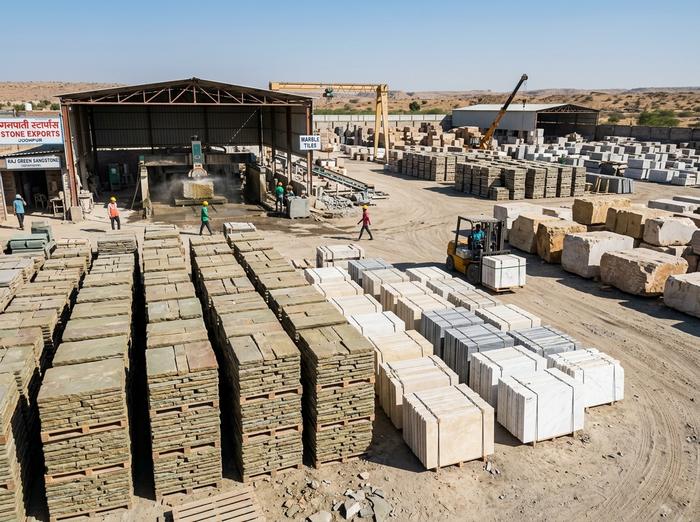
- Sandstone decorative items — fountains, planters and carved panels
- Marble artefacts — bowls, vases, chess sets and small sculptures
The honest part: most of these workshops have no website and no export paperwork. They make beautiful things and sell to whoever walks in. The gap between a great maker and a buyer three countries away is exactly what we fill.
Where Agra orders go wrong
The biggest trap in Agra is the stone itself. Real Pietra Dura uses semi-precious stones — lapis, carnelian, malachite. Cheaper workshops use dyed agate or painted stone and call it the same thing. In a photo you would never tell the difference; after a year of sunlight, the colours bleed.
Then the marble. Natural marble has cracks and veins — that is normal. The problem is workshops that fill wide cracks with tinted resin, polish over, and sell it as solid stone. It looks perfect until it crosses an ocean and the resin line opens up.
Leather is a different headache: inconsistency. One batch of jooties arrives soft and even; the next is stiff with rough edges, because the workshop quietly switched to a cheaper tannery. Without someone on the ground, you find out when your customer complains.
A buyer in Manchester ordered twelve inlay tabletops off beautiful sample photos. What arrived was dyed stone in resin-filled marble — and two tops cracked in transit, packed in newspaper and hope. We hear versions of this constantly. Often the workshop was not dishonest; the buyer just never put in writing what "good" meant, with photos to prove it.
What we actually do for you in Agra
- Visit artisan workshops in person and verify who actually makes what
- Check inlay stones — real semi-precious versus dyed substitutes
- Inspect marble for resin fills, cracks and weak veins before packing
- Run leather QC — stitching, finishing and batch-to-batch consistency
We are your eyes on the ground in Agra, working from Jodhpur, where we have been based since 2012. We are a sourcing and QC consultancy, not a manufacturer — our only job is making sure you get what you paid for. More about us on our main website.
How the Agra inlay trade actually works
The Pietra Dura workshops cluster around Taj Ganj, in the shadow of the Taj itself. The craft is extraordinary — artisans cut semi-precious stones into hairline shapes and set them into marble by hand, exactly as their ancestors did for the Mughal emperors. But the trade has a split personality: a handful of master workshops doing genuine museum-quality work, and a much larger number of units churning out tourist-grade pieces with dyed stones and resin fills.
The stone question is everything. Real lapis, malachite, carnelian, and mother-of-pearl cost real money. Dyed agate and plastic substitutes cost almost nothing and look convincing in photos. We check inlay stones under magnification — natural stones have depth and variation, dyed ones look flat. For significant orders, we ask the workshop to show us their stone inventory. A workshop doing genuine inlay has trays of cut stones; a workshop faking it has a box of dyed chips.
Marble quality is the quieter issue. Good inlay needs dense, crack-free marble. Cheaper workshops use fractured marble filled with resin and polished over. It looks fine on arrival and yellows within a year. We check marble slabs with a strong light behind them — cracks and fills show up immediately. It's a two-minute test that most buyers never see done.
Agra's leather cluster is a separate world, centred in the city's industrial areas. The footwear units range from excellent to awful, and the difference is usually in the finishing — edge paint, stitching consistency, insole quality. Leather QC is hands-on work: we flex the shoes, check the glue joints, and smell the leather (harsh chemical smell means poor tanning). Unromantic, but it works.
How it works
Pricing: our fee is 5–10% of the order value, or a monthly retainer of $1,500–$3,000 depending on scope. A single standalone inspection visit is around $500.
Questions buyers actually ask us
Do you manufacture anything yourselves?
No. We are a sourcing and QC consultancy, founded in 2012 and based in Jodhpur, Rajasthan. We do not own workshops and we do not take a cut from makers, so our advice stays honest.
How can you tell real inlay stone from dyed substitutes?
Experience plus simple checks: natural stones have depth and irregularity; dyed ones sit flat and too even. Where it matters, we test — and we photograph everything so you see what we see.
What will it cost me?
Two models: 5–10% commission on the order value, or a monthly retainer of $1,500–$3,000 depending on scope. A one-off inspection visit is around $500.
Can you handle leather orders too, or just stone?
Both. Agra's leather cluster is half the reason to source from the city. We run the same workshop verification and QC on footwear and leather goods as we do on stone.
How long does a typical order take?
Samples usually take two to three weeks; production four to eight, depending on the piece and order size. We give you a realistic timeline up front — and we will tell you if a workshop's promise sounds too good to be true.
Talk to us about Agra
Tell us what you are looking to source. We will tell you honestly whether Agra is the right place for it, and what it should cost.
qualitylinkglobal@gmail.com
+91 9660837666