Why Barmer matters for sourcing
Most buyers have never heard of Barmer. That's actually an advantage. While everyone crowds into Jodhpur's showrooms, Barmer's quarries and cutting yards quietly produce some of Rajasthan's best-value sandstone — often at better prices, because you're closer to the source and further from the tourist markup.
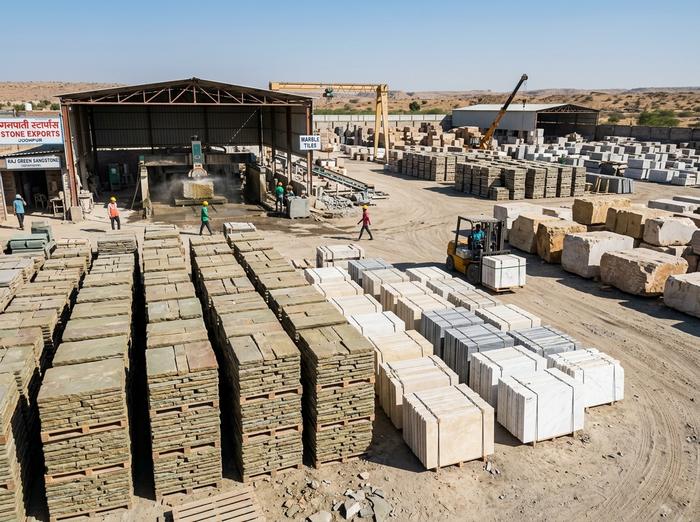
A Barmer stone yard — desert sandstone, cut and calibrated for export paving.
The region produces beautiful sandstone in warm desert tones — pinks, buffs, reds — plus carved limestone and a living tradition of desert woodcraft. The stone here built the region's famous havelis and temples; now it paves patios in Surrey and Sydney.
The trade-off: Barmer is remote. It's a proper desert town, hours from the nearest big city. The infrastructure is thinner, the processors are smaller, and you really don't want to manage this supply chain from a laptop in another country. That's what we're for.
What buyers actually source from Barmer
- Sandstone paving — calibrated pavers, patio slabs, and treads in desert tones. The core Barmer export.
- Carved limestone — architectural carving, jharokhas, brackets, decorative panels in local limestone.
- Sandstone cladding and wall stone — natural split-face and honed finishes for exterior walls.
- Desert woodcraft — traditional carved wooden pieces: chests, panels, furniture made by local artisan communities.
- Cobbles and setts — for driveways and landscaping, tumbled or natural finish.
How sourcing actually works here
Barmer's supply chain is shorter and more direct than the big hubs — which is good, once you find the right people.
Quarry to yard. The stone comes from quarries scattered across the district. Blocks move to cutting yards where they're sawn into slabs or calibrated into pavers. Because the distances are short and the chain is simple, prices can be very competitive — you're not paying for three layers of traders.
But the yards are small. Don't expect Kishangarh-scale operations. A typical Barmer processor might have a few saws and a calibration machine, employing 15–30 people. That's fine for most orders, but it means capacity planning matters — a big order can swamp a small yard. We check actual capacity against your timeline before you commit.
Calibration is the make-or-break. For paving, calibrated thickness is everything. A good Barmer yard calibrates to within 2mm. A sloppy one... doesn't. We check with calipers, because your landscaper in Melbourne will notice what the yard hoped you wouldn't.
Getting it out. Barmer stone travels by road to the rail head, then to Mundra port. The desert roads are what they are — we make sure the packing accounts for the journey, not just the ocean leg.
Where it goes wrong
Colour variation between batches
Desert sandstone varies — that's natural and part of the charm. But there's a difference between natural variation and "we ran out of the good quarry so we mixed in something else." We approve a control range of samples (lightest to darkest acceptable) and hold production to it.
Thickness drift
The first pallets are perfectly calibrated. Then the blades wear, nobody adjusts, and the last pallets are 5mm off. We check calibration throughout the production run, not just at the start.
Salt and desert minerals
Desert stone can carry soluble salts. In most applications it's harmless, but in damp climates it can cause efflorescence — white staining on the surface. For UK and northern European buyers, we flag this upfront and recommend sealing. It's a known characteristic, not a defect — but you should know before you buy, not after installation.
Under-capacity promises
A small yard says yes to an order three times its capacity, then subcontracts to other yards with different stone and different standards. We verify capacity honestly and split orders across verified yards when needed — with your approval, not behind your back.
What happened to a buyer we now work with: A landscaping supplier in Australia ordered two containers of sandstone pavers from a Barmer yard he'd found through a trade directory. The first container was beautiful — perfectly calibrated, lovely colour. The second was from a different quarry entirely: different tone, 4mm thicker, and the edges were chipped. The yard had subcontracted half the order without telling anyone.
Now we inspect every container load separately, and the yard knows we'll walk away from the second container if it doesn't match the first. Funny how that focuses the mind.
Our quality checks, specifically
- Quarry and yard verification: real quarry, real cutting yard, real capacity. We check the stone source matches what's quoted.
- Colour range approval: we establish the acceptable light-to-dark range with physical samples before production.
- Calibration checks: digital calipers on random pieces from every pallet, throughout the run.
- Edge and surface check: chipped edges, sawn vs. calibrated faces, finish consistency.
- Packing for desert roads: pallets strapped and wrapped to survive the road journey to the rail head, then fumigated crates for export.
- Loading supervision: we watch the container being loaded, check the count, photograph the seal.
Local market insights worth knowing
Barmer prices are genuinely good. Because you're near the quarries and dealing with smaller yards, the base prices here often beat Jodhpur for equivalent sandstone. The savings are real — typically 10–20% on paving. Just make sure the QC is tight, because the yards are smaller and less export-polished.
Water is scarce; stone dust isn't. Cutting yards here run on tight water supplies. In peak summer, some yards slow down. It's not a crisis, but it's worth knowing when you're planning timelines for May–June.
The woodcraft is undervalued. Barmer's desert woodcraft communities make beautiful carved pieces that sell for a fraction of what equivalent work costs in Jodhpur. If you're in the handicraft trade, this is worth a look — the carving tradition here is deep.
Don't skip the site visit (yours or ours). Barmer rewards buyers who actually show up — or send someone. The relationships here are personal, and a yard that knows you'll check the goods produces better goods. It's human nature.
What we actually do for you in Barmer
- Quarry and yard verification — real source, real capacity, real export experience.
- Colour and calibration standards agreed in writing before production.
- In-process checks at the yard during cutting and calibration.
- Pre-dispatch inspection, export packing supervision, and container loading with seal photos.
We're a sourcing and QC consultancy based in Jodhpur — not a manufacturer, not a trader. We don't take money from quarries or yards. Our fee comes from you: 5–10% of the order value, or a $1,500–$3,000 monthly retainer if you're buying regularly. Quoted in writing, before we start.
Questions buyers ask us about Barmer
Is Barmer stone as good as Jodhpur sandstone?
For paving and cladding — yes, absolutely. The geology is similar, the colours are beautiful, and the prices are often better. Jodhpur has bigger processors and more export polish; Barmer has better quarry-direct value. For most applications, buyers can't tell the difference once it's laid.
How do I handle the colour variation?
We set a control range with physical samples — the lightest and darkest pieces you'll accept. Production gets checked against that range. Natural stone varies; the trick is agreeing upfront how much variation is acceptable, then enforcing it.
What about the salt/efflorescence issue?
It's a known characteristic of some desert stones in damp climates. For most applications it's minor and fades. For critical applications (light-coloured cladding in rainy climates), we recommend specific sealing — and we'll tell you honestly if a particular stone is wrong for your climate.
How long does an order take?
Standard paving: 4–6 weeks from approved samples. Carved pieces: 8–12 weeks depending on complexity. Add time for the desert logistics — getting heavy stone from Barmer to port isn't instant. We'll give you a realistic schedule.
Can you combine Barmer stone with Jodhpur furniture in one container?
Yes — we do this regularly. Stone from Barmer and furniture from Jodhpur meet at the ICD, loaded under our supervision with proper separation and dunnage. One container, one set of documents, big freight saving.