Why Bhadohi matters for rug buyers
Bhadohi isn't just a town in Uttar Pradesh. It is the heart of India's hand-knotted rug trade. Thousands of looms sit in homes and small workshops across the district, and the best wool carpets in the country come from here. If you sell rugs in the USA, UK, Europe, or Australia, chances are some of your stock has a Bhadohi story behind it.
But here is the catch. Most buyers deal with exporters in Delhi or export houses far from the actual looms. The person taking your order may never see your rugs being woven. We work differently. We are a sourcing and quality-control consultancy, founded in 2012 in Jodhpur, Rajasthan. We are not a manufacturer, and we don't sell carpets. Our only job is to protect your side of the table.
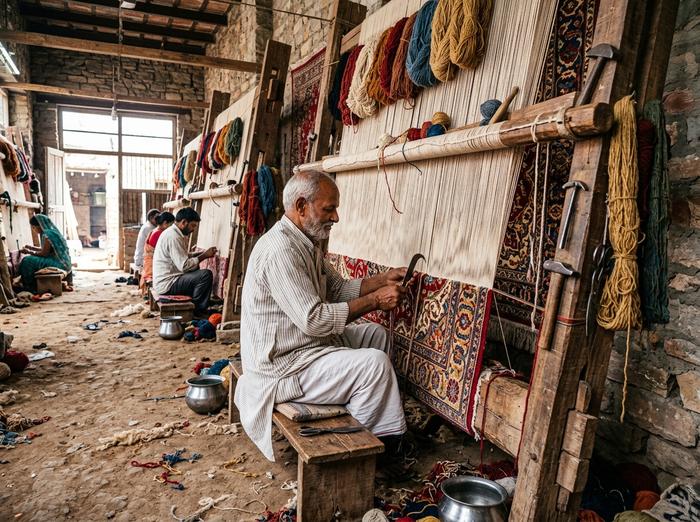

Hariharnath Mandir in Gyanpur — Bhadohi district is the carpet capital of India. (Photo: Wikimedia Commons)
What to source from Bhadohi
- Hand-knotted wool rugs — the premium end. Genuine hand-knotted rugs take weeks or months per piece, and the price reflects the labour.
- Hand-tufted carpets — faster to make, softer on price. Good for mid-range retail lines where hand-knotted margins don't work.
- Jute and cotton dhurries — flatwoven, light, easy to ship. Great for the boho and coastal décor market.
- Indo-Nepalese designs — Tibetan-style weaves in contemporary patterns. A strong seller in the designer segment.
A quick note on knot density, because suppliers love to throw numbers around. Knot count is measured per square inch. More knots means finer detail and a higher price — a 60-knot rug genuinely costs more to weave than a 40-knot one. This is exactly the number most often exaggerated in quotes. We physically check it on the loom, ruler in hand, before you commit.
Where Bhadohi orders go wrong
The most common problem we see: the knot count is lower than promised. A supplier quotes you for an 80-knot weave and delivers a 60-knot one. You can't tell from a photo. You need someone to sit at the loom and count.
Then there's dye lot variation. The sample you approved was a rich indigo. The 200 pieces that arrived are three different shades of blue. Natural and even synthetic dyes shift between batches, and without someone comparing your approved sample against production on site, you find out only when the container opens.
Size shrinkage is another quiet killer. Wool rugs shrink after washing and drying — sometimes 3–5%. A 8×10 that arrives at 7.6×9.8 is a customer-service problem you inherit. Backing and latex issues round out the list: a hand-tufted carpet with a cheap or uneven latex backing will curl, smell, or shed within months.
Real example: a buyer from the UK ordered 150 hand-knotted wool rugs from a well-reviewed exporter. The sample was beautiful. The shipment had a different, lower knot count in half the rugs, and the dyes didn't match the approved colourway. They found out in their warehouse. An on-the-ground check before dispatch would have caught it in an afternoon.
What we actually do for you in Bhadohi
- Loom visits — we go to the actual weaving sheds, not just the exporter's showroom. We see your rugs on the loom.
- Knot-count verification — we count knots per square inch and compare against what you were quoted. Simple, boring, and the thing that saves the most money.
- Dye-lot checks — we hold your approved sample next to production pieces and flag shade differences before they multiply across your order.
- Pre-shipment measurement — we measure finished, washed rugs piece by piece so the sizes on the packing list are the sizes that arrive.
Everything we find comes back to you in a photo report — clear images, plain-language notes, and our honest recommendation on whether to approve, ask for corrections, or hold the shipment. You can read more about how we work on our main site.
How the Bhadohi rug trade actually works
The rugs aren't made in Bhadohi town — they're made in the villages around it, on looms in weavers' homes. An exporter in Bhadohi coordinates hundreds of looms across dozens of villages. Your 9x12 rug might be knotted by a family who've been weaving for three generations, and the exporter might visit them twice during the whole production. This is why on-ground checking matters: the person selling you the rug often hasn't seen it being made.
Knot count is the industry's favourite fudge. A "100-knot" rug (100 knots per square inch) uses more wool, takes longer, and costs more than an 80-knot rug — but you'd need a magnifying glass and patience to tell the difference. We count knots on the back of the rug across multiple spots. If you paid for 100 and got 80, that's not a minor variance — it's a different product at a different price.
Dye lots are the second classic. Wool dyed in different batches can vary noticeably, and a large rug woven over several weeks may use two or three dye lots. The fix is simple: the weaver should dye enough wool for the entire rug upfront. We check this at the loom stage, not after washing. Once it's washed and finished, re-dyeing isn't an option.
Washing itself deserves attention. Bhadohi's washing units use chemicals that can shrink a rug by 3-5% and shift colours if done carelessly. We measure rugs before and after washing on larger orders, and we check the latex backing on tufted pieces — too thin and it cracks within a year, too thick and the rug goes stiff. The right backing is a Goldilocks thing, and most buyers never ask about it.
How it works
What it costs: we charge either 5–10% commission on the order value, or a fixed monthly retainer of $1,500–$3,000 depending on scope. A single one-off inspection in Bhadohi is around $500. No hidden fees — you'll know the numbers before we start.
Questions buyers actually ask us
Do you sell rugs yourselves?
No. We are a sourcing and QC consultancy, not a manufacturer or seller. That is the whole point — we have no interest in which supplier you pick, only that you get what you paid for.
Can you work with my existing supplier?
Yes. Plenty of buyers come to us after choosing a supplier and just want someone checking quality on the ground. We are happy to step in at any stage.
How long does a typical Bhadohi order take?
Hand-knotted rugs usually need 3–5 months from order to shipment, depending on size and knot density. Tufted and dhurrie orders are faster — typically 6–10 weeks. We give you an honest timeline before you commit, not an optimistic one.
What if you find problems during inspection?
We document everything with photos and tell you exactly what we found. You decide: ask the supplier to fix it, negotiate a discount, or hold the shipment. We don't release a green light until it meets your spec.
How do we start?
Email us at qualitylinkglobal@gmail.com or call +91 9660837666. Tell us what you are looking to buy and we'll send you a first consultation — free — with a realistic plan and cost.
Buying rugs from Bhadohi?
Get someone on the ground before your money leaves. First consultation is free.
Or call: +91 9660837666