Why Firozabad matters for glass buyers
Firozabad, a few hours from Delhi in Uttar Pradesh, makes more glass by hand than anywhere else in India. Small furnaces run day and night, and the artisans blow, shape and finish glass by hand — the way their grandfathers did.
Almost everything is made in small workshops — one blows your glasses, another cuts the drops, a third packs. Without eyes on the ground, you are trusting a chain you have never seen. We walk through it for you.
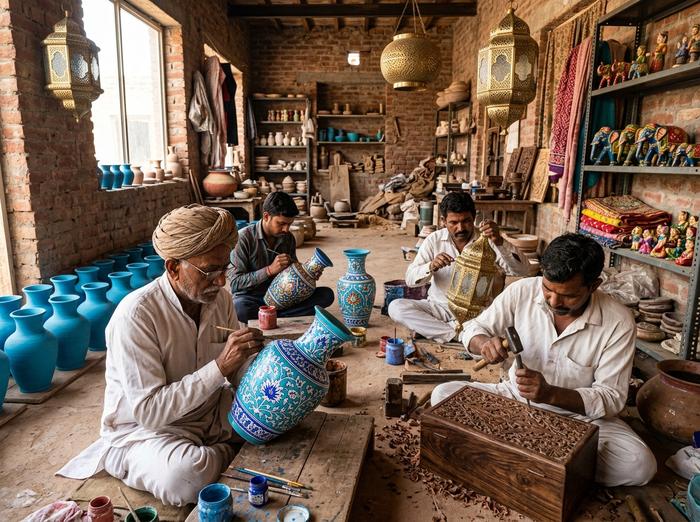

Firozabad — India's glass city, famous for bangles, glassware and chandeliers. (Photo: Wikimedia Commons)
What to source from Firozabad
- Hand-blown glassware — tumblers, carafes, decanters and vases in smoked, amber and coloured glass.
- Crystal chandeliers — cut-glass arms, hanging drops and full multi-tier pieces for retail and hospitality buyers.
- Glass lanterns and candle holders — hurricane lamps, hanging lanterns, tealight holders.
- Coloured art glass — decorative bowls, paperweights, figurines, plus Firozabad's famous glass bangles for fashion-accessory buyers.
A hand-blown carafe that would cost a fortune in Europe comes out of these furnaces for a few pounds. The value is real — but only if quality and packing hold up. That is where most orders fall apart.
Where Firozabad orders go wrong
Breakage in transit — the number one problem. Glass travels badly, and many workshops pack like it doesn't matter: newspaper around a wine glass, single-wall carton. We have seen containers arrive with more broken pieces than whole ones.
Colour inconsistency across batches. Some variation is normal in hand-blown coloured glass — part of the charm. But when amber carafes range from light honey to dark brown in one order, that is a workshop running out of the right glass and carrying on anyway.
Bubbles and inclusions. Tiny bubbles are normal in hand-blown glass. Large bubbles, unmelted bits and scratched surfaces are not — and they ship unless someone is inspecting.
Missing chandelier parts. A chandelier is a kit: arms, drops, pins, canopies, wiring. Miss one bag of pins and the piece cannot be built on arrival. It happens more often than you would think.
A Dutch lighting retailer ordered 40 chandeliers from a Firozabad workshop at a great price. The container reached Rotterdam with nearly 20% of the crystal drops broken and two hardware kits missing — packed in newspaper inside thin cartons, parts counted by hand. We now supervise every chandelier order there: double-wall cartons, dividers, parts counted and photographed before sealing.
What we actually do for you in Firozabad
- Furnace and workshop visits — we visit before you commit, confirm the workshop is real and tell you honestly if it can handle your order.
- Packing supervision — we specify and supervise it: double-wall cartons, cell dividers, proper cushioning. This step prevents more losses than anything else.
- Breakage sampling — we open cartons from your production run and check for damage, bubbles and finish problems before shipment.
- Parts-count checks for chandeliers — every arm, drop, pin and fitting counted, photographed, then sealed.
We are a sourcing and QC consultancy based in Jodhpur, Rajasthan — not a manufacturer, so our only interest is your order arriving right. More about us at qualitylinkglobal.com.
How the Firozabad glass market actually works
Firozabad is not one big factory — it is clusters of small workshops packed into neighbourhoods like Suhag Nagar and the lanes around Sadar Bazaar. Each lane tends to specialise. One street blows tumblers all day. The next one cuts crystal drops. Another does nothing but silvering and finishing. Your order usually passes through several of these hands before it is packed, which is why you need someone who knows the whole chain, not just one workshop.
The furnaces come in two main types. Pot furnaces melt glass in small batches — this is where coloured and hand-blown pieces are made, and where small-batch variation comes from. Tank furnaces run continuously and suit larger, plainer runs. If a workshop quotes you coloured hand-blown tumblers from a tank furnace, something is off — we check the furnace type matches what you are ordering.
Packing is where the market splits. Most domestic workshops pack for the Indian road network: newspaper, single-wall cartons, goods stacked tight. It survives a truck ride to Delhi. It does not survive a container to Rotterdam. A smaller number of workshops — usually the ones already exporting — use export packing: double-wall cartons, cell dividers, tissue between pieces. Part of our job is matching your order to the right kind of workshop, and then supervising the packing anyway.
The specific checks we run on glassware
Glass QC is hands-on work. Here is what we actually do piece by piece: we spin each item on a flat surface to check it does not wobble; we run a finger around every rim for sharp or chipped edges; we hold each piece against the approved colour sample under daylight; we check wall thickness is even (thin spots break first); and we hold pieces up to light looking for stones, large bubbles and scratches. For chandeliers we add the parts count — arms, drops, pins, fittings — checked against the packing list and photographed before the box is sealed.
How it works
What it costs: most buyers pay 5–10% commission on order value, or a $1,500–$3,000 monthly retainer for ongoing sourcing. A single inspection visit is around $500, quoted up front — no hidden fees.
Questions buyers actually ask us
What is the minimum order quantity in Firozabad?
Hand-blown glassware usually starts at 500–1,000 pieces per design; chandeliers can be as low as 10–20 pieces. We confirm the real MOQ per workshop before you commit — some take smaller trial orders.
Can you really prevent breakage in transit?
Glass is glass — we can reduce it dramatically, not eliminate it. Proper packing (double-wall cartons, dividers, cushioning) keeps breakage under 2–3% on orders we supervise, against 15–25% for unsupervised ones.
Do you handle glass bangles too?
Yes, we can source the famous coloured bangles if they are part of a wider order. Our main QC experience sits with home décor glassware, lighting and decorative pieces — that is where we add the most value.
How long does an order take?
Samples take 2–3 weeks. Production runs 4–6 weeks for glassware, 6–8 for chandeliers, plus shipping. We give you a realistic timeline per workshop — not a hopeful one.
Why not just order directly from the workshop?
You can — and for a tiny order, you probably should. But nobody checks the workshop, watches production or inspects before shipment. We exist for orders where a bad container would actually hurt.
Talk to us about your Firozabad order
Send product details, quantities and target prices to qualitylinkglobal@gmail.com or WhatsApp +91 9660837666. We reply honestly — including if the order is not worth our fee.