Why Udaipur matters for sourcing

City Palace, Udaipur — the City of Lakes. Behind the romance: serious artisan workshops.
Udaipur is the city people fall in love with — lakes, palaces, the whole romantic package. What buyers sometimes miss is that it's also a working craft city with real export production: green marble processing, stone carving workshops, miniature painters, and furniture painters doing the colourful distressed and hand-painted pieces that sell so well in Western home décor stores.
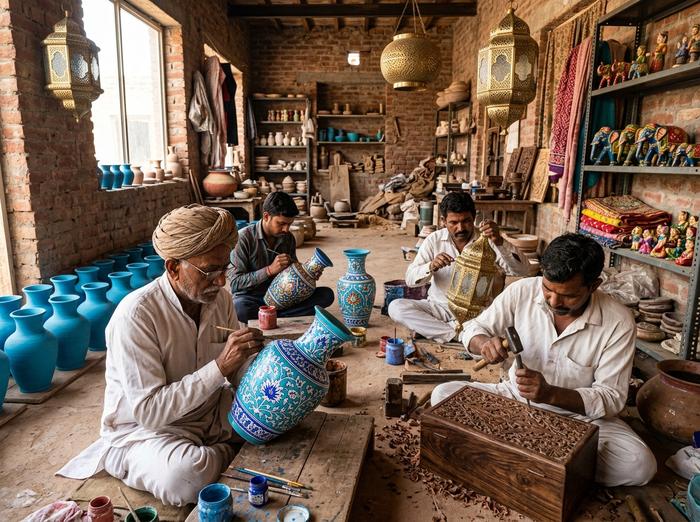
The character here is different from Jodhpur or Kishangarh. The workshops are smaller — often family-run, 5–20 people. The work is more artisanal, less industrial. That's wonderful for unique, high-craft products, and it means the QC approach has to match: you can't apply factory checklists to artisan workshops and expect it to work. We adapt.
One thing to know upfront: Udaipur's craft economy overlaps heavily with its tourist economy. Some "exporters" here are really souvenir shops with a website. Sorting the real workshops from the gift shops is half the job — and it's a job we're good at.
What buyers actually source from Udaipur
- Green marble — Udaipur region green marble slabs and tiles, from deep forest greens to lighter varieties. Distinctive and increasingly popular for feature walls and bathrooms.
- Carved stone artefacts — garden sculptures, fountains, carved panels, traditional and contemporary designs.
- Miniature art — hand-painted miniatures in the Mewar tradition: on paper, silk, and marble. Genuine hand-painted pieces, not prints.
- Painted furniture — hand-painted and distressed cabinets, consoles, and accent pieces in the colourful Rajasthani style that Western retailers love.
- Marble handicrafts — inlay boxes, coasters, candle holders, decorative objects.
How sourcing actually works here
Udaipur's supply chain is personal and small-scale. Here's how it really runs:
Green marble: quarry to cutter. The green marble comes from quarries in the Udaipur region. Blocks go to local cutting units — smaller than Kishangarh's gangsaw operations, but perfectly capable for slabs and tiles. Because the volumes are lower, you get more attention per order — but you also need to plan around limited capacity.
Artisan workshops, not factories. The carvers, painters and miniature artists work in small family units. There's no production line — there's a master artisan and a few apprentices. Quality is high when the master is engaged, and variable when the order gets pushed to juniors. We check who's actually doing your work, not just whose name is on the invoice.
Painted furniture: the process matters. Good painted furniture goes: solid wood base → proper prep and priming → hand-painted design → distressing (if ordered) → protective lacquer. Skip the prep and the paint peels in a year. Skip the lacquer and the first scratch goes to bare wood. We check the layer sequence, not just the pretty topcoat.
Miniatures: know what you're buying. There's a world of difference between a hand-painted miniature (days of work, real value) and a print with hand-touching (minutes of work, souvenir pricing). Both have their market — but you should know which you're paying for. We verify with the artists directly.
Where it goes wrong
Dyed stone sold as natural green
The big one for green marble. Some "green marble" on the market is white or grey marble that's been dyed green — and the dye fades, especially in sunlight or with cleaning chemicals. Natural Udaipur green marble has depth and variation that dye can't fake... but in a photo, they look similar. We check with simple tests (dye concentrates in cracks and pores; natural colour runs through) and we buy from quarries we know.
Painted furniture that peels
Gorgeous in the showroom, peeling in eighteen months. The cause is almost always skipped prep — paint applied directly to raw or poorly primed wood. We check the workshop's actual process: is there a priming stage? What lacquer are they using? We also do adhesion tests (the tape test doesn't lie) on production pieces.
Prints sold as hand-painted miniatures
A print costs almost nothing to produce. A hand-painted miniature takes an artist days. Guess which one gets sold at hand-painted prices? We verify with a loupe — prints have dot patterns; hand painting has brush texture and tiny imperfections. Simple check, big money difference.
Tourist-shop "exporters"
Udaipur has shops that sell to tourists all day and "export" on the side. Their export packing is a cardboard box and hope. Their quality control is "looks nice." If you're buying container quantities, you need a real production workshop, not a retail shop. We verify the difference.
What happened to a buyer we now work with: A home décor retailer in France ordered hand-painted cabinets from an Udaipur supplier — beautiful catalogue, great prices. The first shipment looked stunning. Eighteen months later, customers started reporting peeling paint. The workshop had skipped the priming stage entirely to cut costs and speed up production. The retailer faced a wave of returns and a damaged reputation.
Now we check the painting process layer by layer — literally, we look at pieces mid-production to confirm each stage happened. We also do adhesion tests before anything ships. No peeling since.
Our quality checks, specifically
- Green marble authenticity: dye tests, quarry verification, natural-vs-treated identification before you pay natural-stone prices.
- Painted furniture: process verification (prep → prime → paint → lacquer), adhesion tape tests on production pieces, finish consistency across the batch.
- Miniatures: loupe verification of hand-painted vs. print, pigment quality check, proper mounting and framing.
- Stone carving: detail sharpness, consistency across pieces, structural soundness for larger items.
- Artisan verification: we confirm the actual makers — master vs. apprentice work — and match the workshop to your quality level.
- Export packing: painted furniture needs scratch-proof wrapping; miniatures need rigid flat packing; stone needs proper crating. We supervise it all.
Local market insights worth knowing
Green marble is having a moment. Designers love it right now — deep greens are trending in bathrooms and kitchens across Europe and America. Prices are firm and rising. If you're considering green marble, sooner is better than later.
The artisan premium is real and worth it. Udaipur's best work costs more than mass-produced equivalents — and it's worth more. A genuinely hand-painted cabinet from a master artisan isn't competing with factory furniture; it's a different product. Price it and market it accordingly.
Monsoon affects the lake city too. Heavy rains (July–September) can slow quarry output and make the roads interesting. Plan stone orders around it.
Build relationships, not transactions. Udaipur's artisan workshops respond to loyalty. Buyers who return, pay fairly, and treat the makers with respect get the best work and the best prices over time. The workshops remember who haggled them into the ground — and the quality reflects it. We help you build the right kind of relationship.
What we actually do for you in Udaipur
- Workshop verification — real artisans, real capacity, real export experience (not a souvenir shop).
- Material authentication — natural vs. dyed stone, hand-painted vs. print, solid wood vs. composite.
- Process checks during production — we verify each stage happens, not just the final result.
- Pre-dispatch inspection with photos, export packing supervision, and container loading with seal photos.
We're a sourcing and QC consultancy based in Jodhpur — not a manufacturer, not a trader. We don't take money from workshops. Our fee comes from you: 5–10% of the order value, or a $1,500–$3,000 monthly retainer if you're buying regularly. Quoted in writing, before we start.
Questions buyers ask us about Udaipur
How do I know the green marble is natural and not dyed?
We test it. Dye concentrates in pores, cracks and veins — under magnification the difference is clear. We also verify the quarry source. Natural Udaipur green has a depth and variation that dyed stone can't match, and we'll show you the difference before you buy.
Can you verify that miniatures are genuinely hand-painted?
Yes — with a loupe, in person. Hand-painted work shows brush texture, slight line variation, and layered pigment. Prints show dot patterns (offset) or uniform inkjet texture. We check every batch, because the price difference between real and fake is enormous.
What causes painted furniture to peel, and how do you prevent it?
Skipped prep — that's 90% of peeling cases. Proper sequence: sand, prime, paint, lacquer. We verify each stage happens during production and do adhesion tape-tests on finished pieces. If a workshop won't let us check mid-production, we walk away.
Are the workshops big enough for container orders?
For artisan products — yes, with planning. A family workshop can produce steady output over weeks; they just can't do it overnight. We match your order size and timeline to workshops with proven capacity, and we sometimes split across two workshops for larger orders (with your approval).
Can you combine Udaipur goods with my Jodhpur order?
Absolutely — Udaipur to Jodhpur is a few hours by road. Painted furniture from Udaipur plus solid wood pieces from Jodhpur in one container is a combination we handle regularly. One loading, one set of documents.