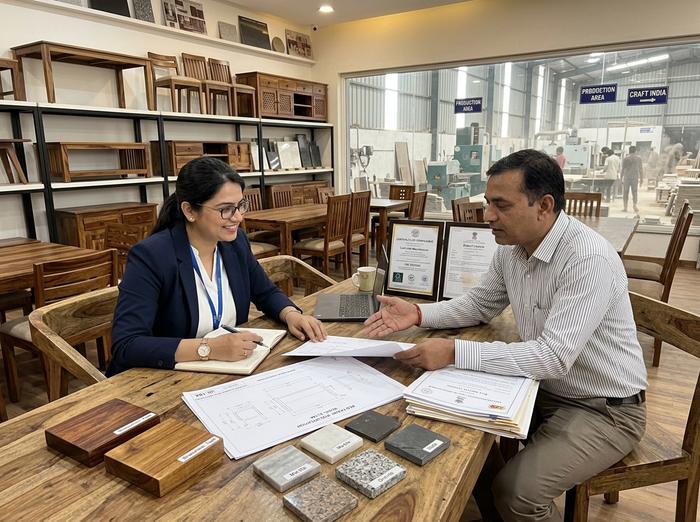
The IHGF Delhi Fair is on this week at the India Expo Centre & Mart in Greater Noida — five days, halls full of handicrafts, home furnishings, gifts, textiles and furniture, and hundreds of Indian suppliers you could never meet one by one from your desk. Buyers who walk in prepared come home with a shortlist of verified suppliers and a pipeline of samples. Buyers who just wander come home with a bag of brochures. This checklist covers how to prepare, how to work the halls, and what to do the week after.
1. Know what the fair covers — and what it does not
IHGF is a handicrafts, home, lifestyle and gifts fair. Expect furniture, home décor, textiles, fashion accessories, festive and Christmas décor, and houseware — organised in product-grouped halls so you can plan your route by category. What you will not find here is sports goods: cricket bats, balls and athletic gear belong to a different trade ecosystem centred on Meerut, and they are not part of this fair. If your range spans both worlds, plan the fair for your décor and home lines and handle sports sourcing through dedicated sports-goods channels instead.
Before you book anything, decide which 2–3 product categories you are actually buying this season. The fair rewards focus. A buyer chasing ten categories across five days ends up with surface-level conversations everywhere; a buyer working two categories properly leaves with real options. If furniture or handicrafts are on your list, read our furniture sourcing and handicraft sourcing overviews first so you arrive knowing the production clusters, the materials, and the questions that matter.
2. Before you fly: build your shortlist on paper
The most productive fair visits start weeks before the flight. Write down, for each category: the exact products, target dimensions, materials, finishes, and the order quantities you can realistically place. Suppliers take you seriously when you can hand them a one-page spec — vague interest gets vague quotes. Our guide to writing clear product specifications shows what that one-pager should contain.
Also set your filters in advance: are you looking for factories or are trading companies acceptable? What is your minimum quality bar — export-grade finishing, specific certifications, private labelling? Decide now, because on a busy show floor it is easy to get charmed by a beautiful booth and forget your own criteria. Bring reference photos of your best sellers and of products you want to develop; a picture ends more confusion than ten minutes of description.
3. Pack a buyer's kit, not just a suitcase
Seasoned fair buyers carry the same small kit every time: plenty of business cards, a notebook (phone notes get lost), a measuring tape, and a camera habit — photograph every booth number next to the products you liked, because by day three all the brass lamps blur together. Carry printed spec sheets for your priority products; handing one over beats dictating dimensions across a noisy hall.
Bring samples of your current products too, especially if you want matching or complementary pieces developed. An exhibitor who can hold your product, check the finish, and discuss construction on the spot gives you a far better read on their capability than a catalogue does. And keep a simple scoring sheet — supplier name, booth, factory or trader, quality impression, quote received, follow-up needed — filled in the same evening while it is fresh.
4. Work the halls with a system
Start with your priority halls on day one, when your energy and attention are sharpest — not with a casual "look around" lap. Walk each relevant hall end to end once, collecting cards and marking the booths worth a second visit; then do your deep conversations on the return pass. This two-pass method stops you from spending forty minutes at the first interesting booth and rushing the rest.
For every promising supplier, capture the same basics: booth number, contact name and mobile, product range, whether they manufacture or trade, their main export markets, and rough lead times. Photograph price lists and product tags where allowed. And resist placing orders on the show floor — the fair is for discovery and comparison. The suppliers worth working with will still be there next week, and you will negotiate better with three comparable quotes in hand than with fair-day excitement.
5. Ask every supplier the same five questions
Consistency is how you compare. Ask each shortlisted exhibitor: (1) Do you manufacture this yourself, and where is the factory? (2) What are your minimum order quantities per design and per shipment? (3) What is the realistic lead time from order to shipment? (4) Which countries do you already export to? (5) Can you customise design, size, finish and packaging for our brand? The answers — and how directly they are given — tell you as much as the products on display.
Watch for the warning signs our manufacturer verification guide describes: reluctance to share a factory address, no export documentation, pressure to commit on the spot, or quotes that seem disconnected from the quality on show. A genuine manufacturer answers factory questions easily; a trader deflects them. Note which is which on your scoring sheet — you will thank yourself later.
6. The week after: samples first, orders later
The fair ends; the real work starts. Within a week, email every shortlisted supplier with a written recap of what you discussed — products, specs, quantities, quoted terms — and request samples of the exact items you want to develop. Samples are the bridge between a promising conversation and a real product; our sample request and evaluation guide walks through getting them right.
Evaluate samples against your spec sheet, not your memory of the booth. Then, before any deposit moves, verify the supplier properly: factory visit or third-party verification, document checks, and references. The fair gave you the shortlist — verification turns it into a supply chain. Buyers who follow this sequence rarely get burned; buyers who skip it because "we met them at the fair" learn the expensive lesson that a booth is not a factory audit.
Frequently asked questions
Is the IHGF Delhi Fair worth it for small or first-time buyers?
Yes — it is one of the most efficient ways to meet a large number of Indian suppliers in a few days, which is especially valuable when you cannot yet justify repeated factory trips. Go with a focused product list, collect contacts and quotes, and start with samples rather than large orders.
What products are not covered at IHGF?
Sports goods are the notable exclusion — cricket equipment, leather balls and athletic gear trade through a separate ecosystem centred on Meerut and do not exhibit at IHGF. The fair focuses on handicrafts, home furnishings, gifts, textiles, furniture and festive décor.
How do I verify an exhibitor is a real factory and not a trader?
Ask for the factory address, GST registration and export documents at the booth, then verify after the fair: a physical visit or third-party verification, production photos and videos, and references from existing export buyers. Never send a deposit based on a booth conversation alone.
Should I place orders at the fair itself?
No. Use the fair for discovery: collect quotes, compare suppliers, and shortlist. Place orders only after you have evaluated physical samples against written specifications and verified the supplier. You will get better terms with competing quotes in hand than with on-the-spot enthusiasm.

Published by QualityLink Global Sourcing Team
Operating directly out of Jodhpur and Jaipur, Rajasthan. Our team provides hands-on supplier verification, factory audits, moisture testing, quality control, and container loading supervision across North India.
Need On-the-Ground Sourcing or QC Support in India?
If you have a prospective supplier in Rajasthan or North India, an active production run, or upcoming container loading, we can step onto the factory floor to verify specs and eliminate export risks.