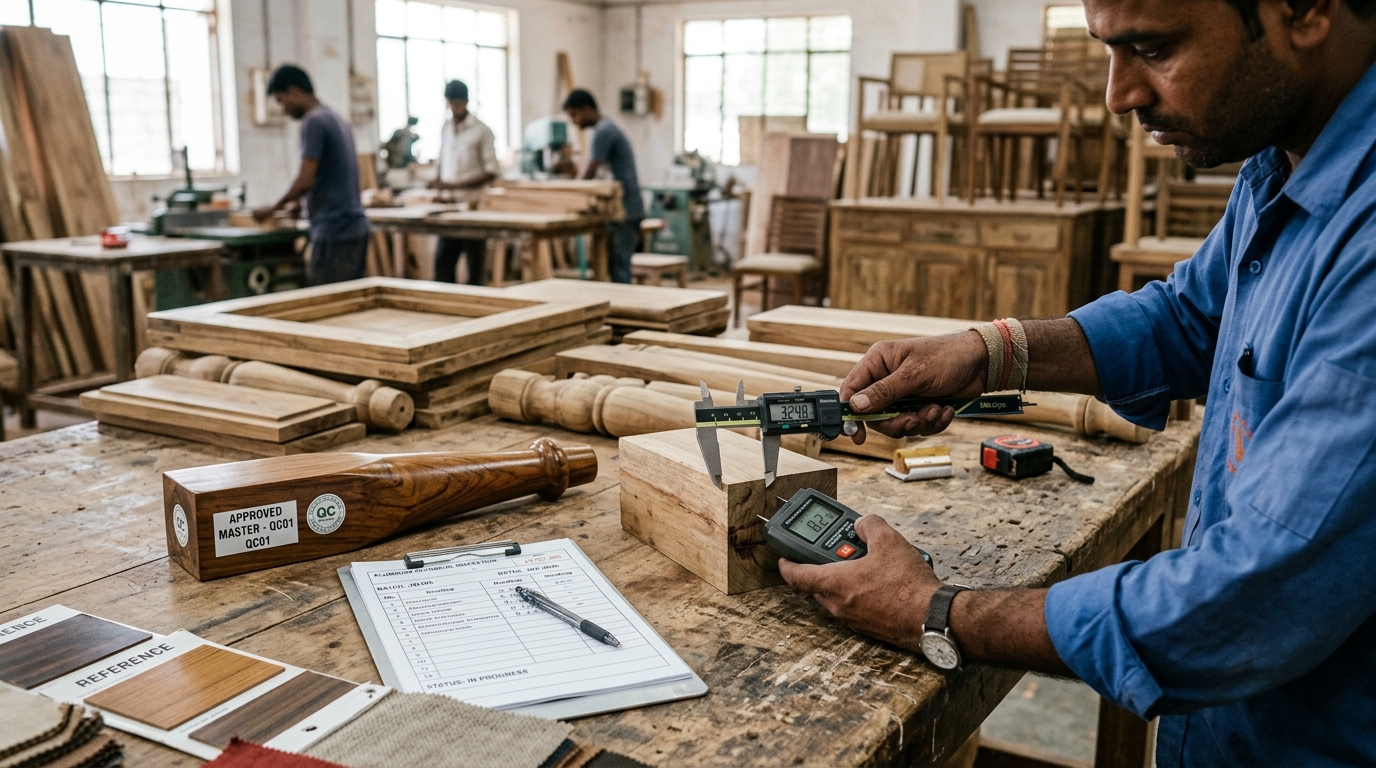
It is the single most common frustration experienced by overseas buyers sourcing from India: you receive a pre-production sample that is virtually flawless—dense timber grain, accurate dimensions, smooth lacquer sheen, and tight joinery. Reassured, you approve the sample, sign the purchase order, and wire a 30% advance deposit.
Three months later, when the shipping container arrives at your warehouse in Felixstowe, Rotterdam, or Long Beach, the bulk shipment tells an entirely different story. The wood color varies from board to board, drawer slides stick, drawer bottom panels rattle, and several tabletop joints show hairline shrinkage cracks. What happened between the prototype and the container?
This discrepancy is known across international trade as "The Golden Sample Trap." In Indian artisan and craft manufacturing, this variance is rarely caused by malicious intent; rather, it stems from structural differences in how prototypes and mass production lots are manufactured. Here is an honest breakdown of why sample drift occurs and the exact quality control protocols that prevent it.
1. The Four Root Causes of Sample Drift in Indian Factories
A. The Master Craftsman vs. Assembly Line Reality
In manufacturing hubs like Jodhpur (wood furniture), Moradabad (brassware), or Sitapura (handicrafts), factories employ a small core of generational master artisans (often called ustads or senior foremen). When a new international client requests a sample, the factory owner assigns the job directly to their top master craftsman. The master artisan hand-selects prime timber cuts, planes them with individual care, tunes the joinery by eye, and applies four coats of hand-rubbed finish over several days.
However, when your commercial order of 300 dining chairs and 80 sideboards enters production, the master artisan is not building each piece. The job is distributed across general shop-floor carpenters, machine operators, and contract sanding labor. Without strict digital jigging and formal standard operating procedures (SOPs), individual variations multiply across hundreds of units.
B. Raw Material Grade Drift and Timber Sapwood
For a single sample dining table requiring 0.15 CBM of Sheesham or Mango wood, the factory easily sources prime heartwood with uniform grain and zero defects. But for an entire 40HQ container requiring 35–45 CBM of sawn lumber, raw material scarcity comes into play. To preserve their profit margins against agreed FOB rates, suppliers often mix secondary sapwood (which is lighter in color, softer, and more susceptible to beetles) into hidden structural components, drawer sides, or underside stretchers.
C. Unauthorized Shop-Floor Subcontracting
When an Indian manufacturer books more container orders than their in-house capacity can fulfill before festive shutdown periods, they face a choice: admit their delay, or secretly farm out structural sub-assemblies to small external cottage workshops. The external workshop rarely possesses the primary factory's kiln seasoning standards, automated wide-belt sanders, or climate-controlled finishing booths. By the time the pieces return to the primary factory for final carton packing, dimensional and finishing errors are already baked into the product.
D. Tooling Wear and Finish Batch Variations
In handcrafted and semi-mechanized production, router bits dull, sander grits wear smooth, and lacquer blends vary from batch to batch. In North India's dry winter vs humid monsoon seasons, ambient moisture and drying times shift dramatically. A lacquer schedule that cured in 4 hours during May might take 18 hours in August, leading to surface blushing, orange peel texture, or solvent trapping under the topcoat.
2. How Experienced Importers Prevent the Golden Sample Trap
Relying on good faith or WhatsApp promises does not prevent production drift. Professional procurement teams implement an objective, three-step sample governance protocol:
| Sample Phase | Traditional Buyer Mistake | Best Practice Protocol |
|---|---|---|
| Pre-Production Sample (PPS) | Evaluates only photos or approves sample without physical retention. | Tripartite Sealed Sample Protocol: Produce 3 identical samples. Client keeps #1; Factory seals #2; Independent QC holds #3. |
| During Production (20%–30%) | Waits until shipment date to ask if goods are finished. | During-Production Inspection (DPI): On-site audit while raw wood joinery is open and unlacquered to catch moisture & fitment errors. |
| Final Pre-Shipment (100% Ready, 80% Packed) | Releases final balance payment based on supplier packing photos. | AQL 2.5 PSI: Random sampling pull according to ISO 2859-1. Comparing mass production directly against Sealed Sample #3. |
3. The Tripartite Sealed Master Sample Protocol
Never leave the sole master sample in the factory's possession. When sample development concludes, insist that the workshop produce three identical pieces under representative production conditions:
- Master Sample A (Buyer Reference): Shipped by air courier to your home office for marketing photography, retail cataloging, and internal benchmark approval.
- Master Sample B (Factory Shop-Floor Benchmark): Signed with indelible marker across unexposed timber, sealed with tamper-evident security tags, and displayed on the factory floor as the visual tolerance standard for shop carpenters and finishing staff.
- Master Sample C (Inspector Reference): Stored at our local Jodhpur/Jaipur office. When our inspector arrives for pre-shipment inspection, they bring Master Sample C onto the packing line to conduct direct side-by-side color matching, sheen verification, and joint fit comparison.
4. Why the During-Production Inspection (DPI) Is Your Ultimate Safety Net
Most first-time importers rely solely on final pre-shipment inspections. While a PSI is essential, discovering that 200 dining tables have 16% core moisture or incorrect mortise joint tolerances when the goods are already lacquered and boxed inside 5-ply export cartons puts you in an agonizing bind:
- Do you delay your retail launch by 6 weeks while the factory strips and re-kilns the timber?
- Or do you accept a compromised discount and risk customer returns in your destination market?
A During-Production Inspection (DPI) conducted when 20% to 30% of your order has passed basic machining and frame assembly solves this problem entirely. At this stage, raw timber moisture can still be measured directly across fresh core cuts. Misaligned tenons can be adjusted before glue cures, and stain swatches can be verified under natural daylight before hundreds of pieces receive final polyurethane topcoats.
Determine Your Statistical Inspection Sample Size
Use our interactive ISO 2859-1 / ANSI ASQ Z1.4 calculator to determine how many units must be independently inspected for your batch size to maintain AQL 2.5 defect tolerances.
Open Interactive AQL Calculator →5. Creating an Unambiguous Quality Specification Sheet
To eliminate subjective disputes over what constitutes "acceptable handmade character" versus a commercial defect, every purchase order should be accompanied by a technical tolerance sheet defining clear parameters:
- Moisture Content Envelope: 8% to 12% maximum pin-type meter reading across all components. (Zero tolerance for timber exceeding 14%).
- Dimensional Tolerances: Critical fitment dimensions (e.g. chair seat height, table leg clearance) limited to ±2mm. Overall exterior case dimensions limited to ±4mm.
- Color Uniformity & Sapwood Allowance: Maximum 10% sapwood on concealed internal framing; zero un-stained sapwood on primary tabletop surfaces.
- Hardware Standards: Soft-close concealed hinges tested for 5,000 cycles; drawer extension glides rated for 30kg working load.
- Carton Drop Resistance: ISTA-1A certification (surviving 10 corner and face drops from 76cm height without product fracture).
Summary
In Indian artisan manufacturing, a prototype proves that the factory *can* make the item correctly once. A rigorous quality control protocol ensures that the factory makes it correctly *hundreds of times consecutively*. By establishing sealed reference samples, scheduling early during-production audits, and inspecting before balance payments leave your bank account, you turn the Golden Sample from an expensive trap into an exact production blueprint.