
Ask any buyer who has opened a container of wooden furniture from India to find split tabletops, and you will hear the same story. The sample was perfect, production looked fine, and somewhere between the factory gate in Jodhpur and a warehouse in Hamburg the wood moved. Nine times out of ten, the culprit is moisture. Quality inspection for products made in India has to include moisture testing, because timber that leaves the factory too wet keeps drying inside the container — shrinking, warping, and cracking while it travels. This field guide covers how experienced buyers test moisture content on the factory floor: which meter to use, where to probe, what the readings mean for sheesham, mango, and acacia, and what to write into your purchase order so the argument is settled before production starts.
1. Why Moisture Content Decides Whether Your Furniture Survives the Voyage
Wood never stops exchanging moisture with the air around it. A board settles at an equilibrium set by the temperature and humidity of wherever it sits. A tabletop at 16% moisture in a Jodhpur workshop in October will spend the next months trying to reach equilibrium with a centrally heated living room in January. It shrinks across the grain as it dries — joints open, glue lines fail, wide solid panels split along their weakest point. Then there is the voyage itself — six weeks at sea, day-night temperature swings, condensation raining off the container roof. If the timber is already near its safe moisture limit when it goes in, there is no margin left for the journey. Our furniture sourcing team treats moisture readings as a go/no-go checkpoint, not a nice-to-have.
2. The Numbers That Matter: What Readings Mean for Sheesham, Mango, and Acacia
Inspectors read moisture content (MC) as a percentage of the wood's oven-dry weight. For export furniture bound for Europe or North America, most buyers work to a simple band. 8–12% MC is the safe zone for interior furniture. Below 8%, timber is over-dried for most indoor uses — it will take on moisture at the destination and swell, and over-dried boards often arrive with checks already in them. Above 12%, the risk of movement climbs. Above 16–18%, most inspectors fail the piece outright: mould, fungal staining, and serious warping become likely, not just possible.
Species behave differently inside those bands. Sheesham is dense and slow to dry; a thick leg can read 10% on the surface and 16% an inch in, because the core lags the face by weeks. Mango wood is lighter and dries faster, but rushed drying leaves hairline surface checks. Reclaimed timber is usually stable, but reclaimed boards sit in open yards through the monsoon — test them like new timber. There is a longer treatment of drying methods in our guide to wood seasoning and kiln drying for sheesham and mango furniture.
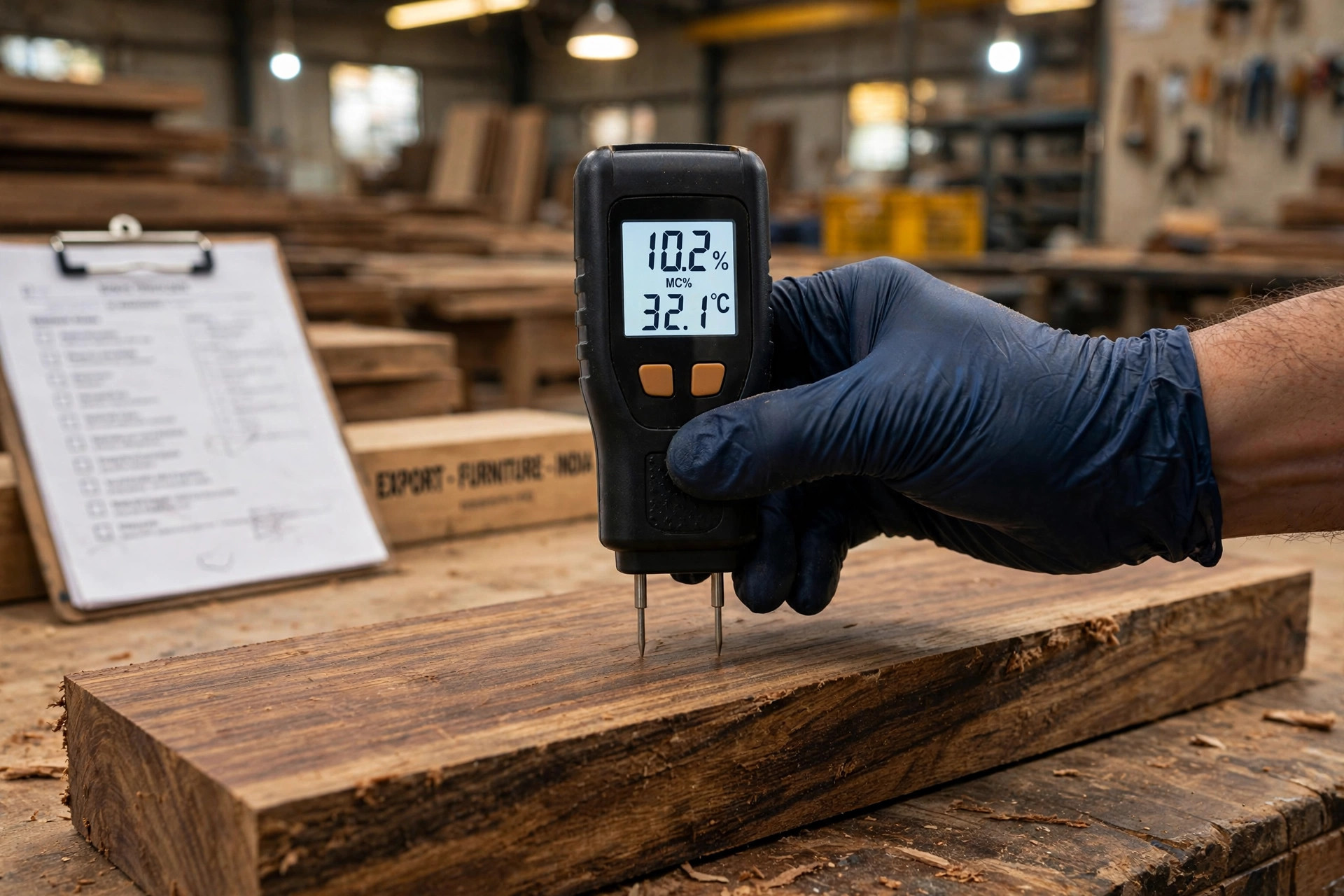
3. How Inspectors Test: Pin Meters, Pinless Meters, and Where to Probe
The pin-type meter is the workhorse. Two pins are driven into the wood and the meter measures electrical resistance between them, which falls as moisture rises. It reads at pin depth — exactly what you want when the surface lies. The trade-off is two tiny holes per reading, so probe hidden spots: undersides, backs of legs, inside aprons. Drive pins along the grain; across-grain readings run high.
The pinless (electromagnetic) meter scans without marking the wood, averaging moisture over a few centimetres of depth. It is the right tool for finished surfaces and for scanning a lot of pieces quickly. It has blind spots: metal fasteners fool it, it struggles on very thin stock, and uneven density throws it off. Most inspectors carry both — pinless to scan, pin-type to settle arguments.
Where you probe matters more than which meter you hold:
- Thickest sections first — table legs, arm posts, stretcher bars. Thin parts dry fast; thick parts hide moisture.
- Middle of boards, not just ends. End grain dries fastest, so pair every end reading with a mid-board reading.
- Unfinished areas. Finish slows surface drying, so a lacquered face reads drier than the core. Probe raw wood wherever the design allows.
- Across the lot, not one corner of the stack. Pull pieces from different pallets and different positions in the pile.
Record every reading against the piece it came from. A report that says "average 10.5%" can hide two pieces at 17% — and those two are the ones your customer will photograph. A quality control inspection is only as good as its raw data.
4. When to Test: Three Checkpoints That Actually Catch Problems
Checkpoint one: timber intake, before a single joint is cut. Test incoming boards at the yard. If stock sits at 16% or higher, the schedule needs kiln time before machining starts. Rejecting wet timber at intake costs nothing; rejecting it later costs everything.
Checkpoint two: mid-production, after machining, before finishing. This is the last moment to catch wet timber without scrapping finished goods — and the checkpoint buyers skip most often. Once lacquer seals the surface, you cannot dry the core without stripping the piece. A half-day inspection at this stage saves more money than any other QC visit on a furniture order.
Checkpoint three: pre-shipment, as part of the final inspection. Test finished pieces, probing unfinished areas, and cross-check against the mid-production readings. If the numbers have climbed, the finished goods sat in humid storage — find out where before the container is booked. Read about what happens during a pre-shipment inspection in India to see where moisture testing fits in the full routine.
Testing only at pre-shipment is testing too late. By then the furniture is finished and packed; a failed reading means rework, re-finishing, and a delayed vessel.
| Moisture Reading | What It Usually Means | What To Do |
|---|---|---|
| 6–8% | Over-dry for most indoor furniture; risk of swelling and checking at destination | Confirm the target climate; allow acclimatisation; check for existing splits |
| 8–12% | Safe zone for interior furniture bound for temperate markets | Pass — proceed to finishing and packing |
| 12–14% | Borderline; risky for wide solid panels | Hold — re-test after further drying; tighten sampling |
| 14–18% | Too wet for finished furniture; warping and joint failure likely | Fail — return timber to kiln or dry storage; do not finish or pack |
| Above 18% | Timber not ready for production; mould and fungal staining risk | Fail — timber needs serious drying before it enters production |
5. What to Put in Writing: Moisture Clauses for Your PO and Inspection Brief
Moisture disputes are miserable because they happen after the money is spent. The fix is a short clause in the purchase order, agreed before production:
- State the target plainly: "Moisture content 8–12% at pre-shipment, measured with a calibrated pin-type meter on unfinished areas."
- Define the method: species-corrected readings, pins along the grain, minimum three readings per piece, on a defined share of pieces.
- Define failure: any piece above 14% fails; a lot with too many pieces in the 12–14% band is held for re-testing, not shipped on a promise.
- Require kiln-drying for solid stock above a stated thickness — air-seasoning alone is not enough for export furniture.
- Require calibration. Pin meters drift; ask your inspector for a calibration check before the readings count.
Suppliers who dry their timber properly are happy to sign this. If you run pre-shipment inspections through a third party, attach the same clause to the inspection brief so the inspector tests to your standard, not theirs.

6. When the Reading Fails: Red Flags on the Factory Floor
Meters give you numbers; the factory gives you context. Watch for these:
- No kiln on site, only open-air stacking. Fine for rough stock. Not fine for finished furniture heading to a heated interior in northern Europe.
- Timber stored uncovered through the monsoon. Boards soak up rain from June to September; the surface looks dry by October while the core is still wet.
- A green-wood smell in the finishing room. If you can smell fresh timber where pieces are being lacquered, moisture is being sealed in.
- The inspector tests one piece, on the finished top. That is theatre, not inspection.
- Readings cluster suspiciously tight. Real timber varies. Identical readings across twenty pieces usually mean a broken meter or invented numbers.
- The supplier resists the moisture clause. Workshops that dry properly sign it without blinking.
None of these replaces the meter, but all of them tell you whether the numbers deserve trust. Moisture testing is cheap — a meter costs less than one replacement tabletop shipped back across the world. For a wider view of what goes wrong with Indian furniture shipments, see our rundown of common quality issues with Indian furniture and how to prevent them.
Frequently Asked Questions
What moisture content should wooden furniture from India be at before shipment?
For interior furniture bound for Europe or North America, 8-12% moisture content is the safe zone. Measure with a species-corrected pin-type meter on unfinished areas, at least three readings per piece. Above 14% should fail; the 12-14% band should be held and re-tested after further drying.
Can I rely on a pinless moisture meter alone?
A pinless meter is excellent for scanning many pieces quickly and for finished surfaces. But it averages over depth, is fooled by metal fasteners, and struggles on thin stock. Use it to scan, then confirm thick sections and disputed readings with a pin-type meter.
Does kiln-dried timber stay dry?
No. Wood re-absorbs moisture from humid air, so kiln-dried boards stored uncovered through the monsoon can be wet again within weeks. Covered storage and re-testing at intake, mid-production, and before finishing keep the numbers where you need them.
Should moisture testing be part of my pre-shipment inspection?
Yes — but not only there. Test at timber intake, again after machining and before finishing, and finally at pre-shipment. Wet timber caught at intake costs nothing; caught at pre-shipment it means rework, re-finishing, and a delayed vessel.

Published by QualityLink Global Sourcing Team
Operating directly out of Jodhpur and Jaipur, Rajasthan. Our team provides hands-on supplier verification, factory audits, moisture testing, quality control, and container loading supervision across North India.
Need On-the-Ground Sourcing or QC Support in India?
If you have a prospective supplier in Rajasthan or North India, an active production run, or upcoming container loading, we can step onto the factory floor to verify specs and eliminate export risks.