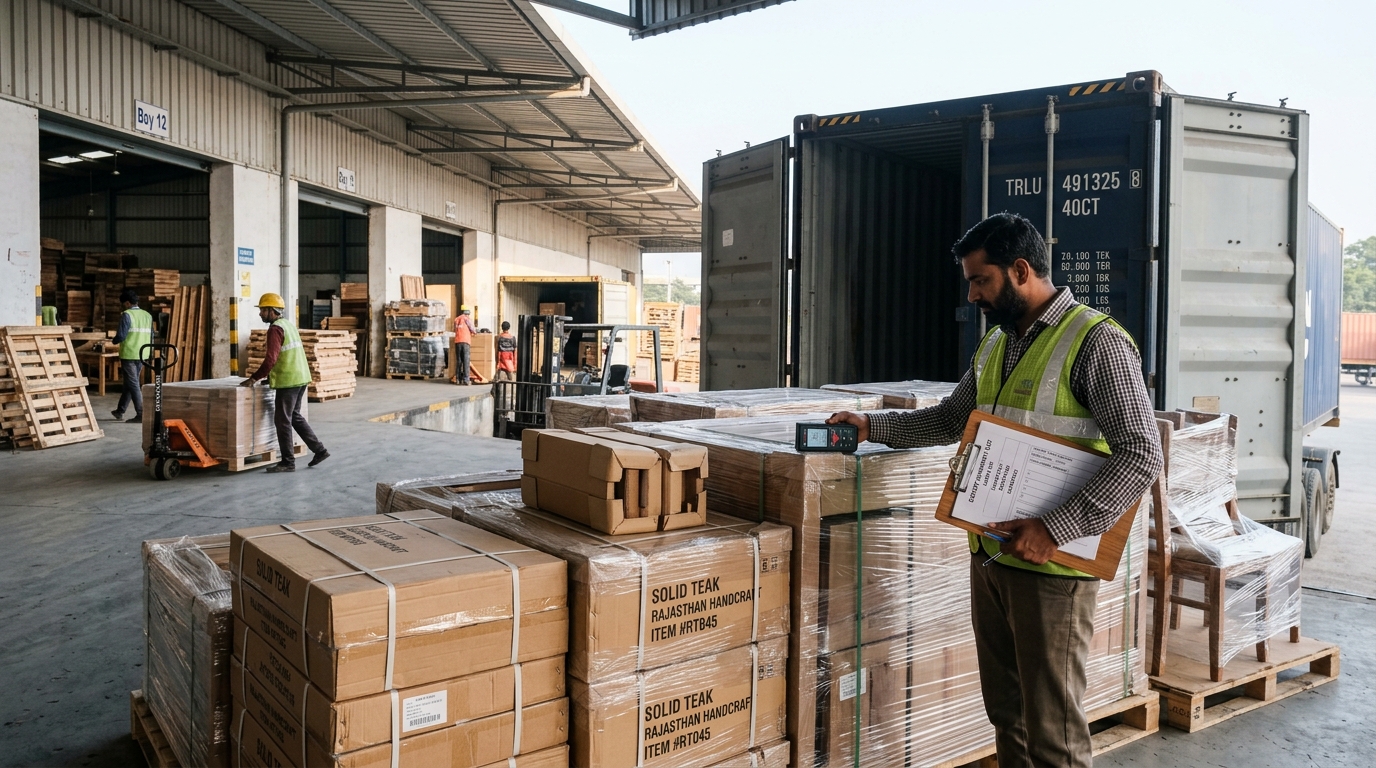
Three letters on a quotation — FOB, EXW, CIF, DDP — decide who carries the risk if a container is damaged, who arranges the freight, and who clears the goods through customs. Get them wrong and a smooth order turns into a dispute about a shipment that was never clearly anyone's responsibility. This guide explains the Incoterms you will actually see on Indian supplier quotations, in plain language, with the India-specific traps buyers fall into.
Incoterms are the International Chamber of Commerce's standard trade terms, currently in their 2020 version. There are eleven in total: seven work for any mode of transport, and four — FAS, FOB, CFR, CIF — are for sea and inland waterway only. For most buyers importing from India, four terms do almost all the work: EXW, FOB, CIF, and DDP.
1. What those three letters actually decide
An Incoterm settles three practical questions, and only those three:
- Where risk transfers. The exact point at which loss or damage stops being the seller's problem and starts being yours.
- Who arranges and pays for carriage and insurance up to the agreed point — and who handles export and import clearance.
- Who handles the paperwork at each border: export clearance in India, import clearance in your country.
What an Incoterm does not decide: when ownership of the goods passes to you, your payment terms, or what happens if someone breaches the contract. Those belong in your purchase agreement, not in three letters. For how freight choices interact with the term you pick, see our sea vs air freight guide; for the full cost picture, our landed cost guide walks through every cost layer beyond the unit price.
2. The four terms on almost every Indian quotation
EXW — Ex Works (named place). The seller makes the goods available at its own premises — say, the factory gate in Jodhpur. From that point, everything is yours: loading, inland transport, export clearance, freight, insurance, import clearance. EXW looks simple on paper, but in India it has a real catch: export clearance must be completed in India, and a foreign buyer with no local presence often cannot do it smoothly. Many experienced buyers treat EXW as a starting point for negotiation rather than a term to accept as-is.
FOB — Free On Board (named port of shipment). The seller delivers the goods on board the vessel at the named port — for example, FOB Nhava Sheva — and clears them for export. Risk transfers the moment the goods are on board. This is the workhorse term of Indian exports: the seller handles everything up to the ship's rail at an Indian port, and you take over from there.
CIF — Cost, Insurance and Freight (named port of destination). Delivery and risk transfer work exactly like FOB — risk still passes when the goods go on board at the Indian port — but the seller additionally contracts and pays for the sea freight and minimum marine insurance to your destination port. CIF does not mean door-to-door: it ends at the port, and you still handle import clearance and onward transport.
DDP — Delivered Duty Paid (named place of destination). The maximum obligation on the seller: goods delivered to your named place, cleared for import, with duties handled. Before accepting DDP from an Indian supplier, satisfy yourself that they can genuinely clear goods through customs in your country — many cannot, and a DDP promise from a seller with no import capability at destination is a dispute waiting to happen. Our customs valuation guide explains what proper clearance involves.
To compare any two terms side by side, the Incoterms comparison tool lays out who is responsible for transport, insurance, customs clearance, and costs under each term.
3. The "FOB Jodhpur" mistake: sea terms don't work inland
FOB, CFR, CIF, and FAS exist only for sea and inland waterway transport. Yet quotations reading "FOB Jodhpur" or "CIF Delhi" circulate constantly — Jodhpur is hundreds of kilometers from the nearest seaport, so the term is meaningless as written and the risk-transfer point is undefined.
The correct term for handing goods to a carrier at an inland point is FCA — Free Carrier (named place): risk transfers when the seller hands the goods to the carrier or another person nominated by the buyer at the named place, which can be the factory itself. If your supplier writes "FOB Jodhpur," ask them to re-quote as FCA Jodhpur with the handover point named — it costs nothing to fix and removes a genuine ambiguity from your contract.
4. Why EXW quotes from India deserve a second look
EXW is common on first quotations because it is the simplest price for a factory to give: no freight to arrange, no port logistics. But remember what you are accepting — under EXW, export clearance in India is your responsibility. Indian export documentation involves the shipping bill, GST-related export paperwork, and port procedures that are difficult to manage without a local entity or agent. Our export documentation guide shows how much paperwork sits behind a container leaving India.
In practice, most first-time buyers end up on FOB (the seller, who does this weekly, clears the export) or FCA for inland handover. If a supplier will only quote EXW, that is useful information in itself — factor in local support for the export side before you compare that quote against an FOB one.
5. The details your paperwork must contain
An Incoterm is incomplete without two companions. Every proforma invoice, purchase order, and sales contract should state all three, identically:
- The three-letter term — FOB, CIF, FCA, and so on.
- The named port or place — "FOB Nhava Sheva," not just "FOB." The named place is part of the deal; without it, nobody can say where the seller's responsibility ended.
- The version — "Incoterms 2020." Terms get revised (the current version is published by the International Chamber of Commerce), and naming the version prevents arguments about which rulebook applies.
When the PI says "CIF Felixstowe Incoterms 2020" and the purchase order says "CIF UK," you have a discrepancy a freight forwarder will not resolve for you. Match the wording across every document. Our complete shipping guide covers how the term flows into booking and documentation.
6. Matching the term to your inspection and shipping plan
The Incoterm shapes your quality-control timeline. Under FOB, the natural inspection moment is before the goods go on board at the Indian port — a pre-shipment inspection at the factory, plus supervision of the container loading, covers the period while the goods are still the seller's risk. Under EXW, you own the risk from the factory gate, so the inspection must happen before you accept the goods there — afterwards, any defect found in transit is much harder to attribute.
Under CIF, check whose insurance actually covers what: the seller arranges minimum cover to the destination port, but that policy protects the seller's interest during the voyage and may not match the cover you would choose. And under DDP, confirm the import duty treatment in writing — "duty paid" should mean exactly that, with the mechanism named.
Three letters, chosen deliberately and written completely, remove an entire category of dispute from your India orders. Our import duties guide for the US, EU, and UK is the natural next read once the term is settled.
Frequently Asked Questions
Which Incoterm do most Indian exporters quote?
FOB a named Indian port — such as Nhava Sheva or Mundra — is the most common starting point, with many suppliers also offering CIF to the buyer's destination port or EXW from the factory on request. If a quotation shows no Incoterm at all, ask for one before comparing it against other quotes.
Can I use FOB if my supplier is in Jodhpur?
No — FOB is strictly for sea transport and names a port of shipment, and Jodhpur is landlocked. The correct equivalent is FCA Jodhpur, naming the exact handover point where the seller delivers the goods to your carrier. Ask the supplier to re-quote; it is a wording fix, not a price change.
Does CIF cover my goods all the way to my warehouse?
No. Under CIF the seller's responsibility — and the risk transfer — ends when the goods go on board at the Indian port, even though the seller pays freight and insurance to your destination port. Import clearance, duties, and onward transport to your warehouse remain yours to arrange.
Where exactly must the Incoterm appear in my paperwork?
On the proforma invoice, the purchase order, and the sales contract — with identical wording each time: the three-letter term, the named port or place, and the version (Incoterms 2020). If the documents disagree, the disagreement becomes the dispute.

Published by QualityLink Global Sourcing Team
Operating directly out of Jodhpur and Jaipur, Rajasthan. Our team provides hands-on supplier verification, factory audits, moisture testing, quality control, and container loading supervision across North India.
Need On-the-Ground Sourcing or QC Support in India?
If you have a prospective supplier in Rajasthan or North India, an active production run, or upcoming container loading, we can step onto the factory floor to verify specs and eliminate export risks.