Kashmir Carpet Sourcing in India: Hand-Knotted Silk & Wool Carpets from Srinagar
Hand-knotted silk and wool carpets from Kashmir — knot density checked, fibre verified, and authenticity confirmed before you pay the balance
Why Source Kashmir Carpets Through an Agent
Kashmir's hand-knotted carpets are among the finest India makes — silk and wool, knotted by hand on a loom in Srinagar, with a GI tag that ties the craft to the place. A genuine Kashmir carpet takes weeks or months to knot, and its value sits in the knot density, the fibre and the dye. That is also why it is faked: machine-made carpets sold as hand-knotted, mercerised cotton sold as silk, and a GI tag claimed on a carpet that was never made in Kashmir.
As your on-the-ground agent, we check the carpet the way it should be checked — knot density counted, fibre tested, dye checked, and the GI-tag paperwork confirmed — before you pay the balance.
- Knot density (KPSI), counted: Knots per square inch measured on the back of the carpet, so a "fine" carpet is a measured fact, not a sales claim.
- Fibre, verified: Silk vs wool vs cotton confirmed — so mercerised cotton is never sold to you as silk.
- Dye & colourfastness: Natural and synthetic dyes checked for colourfastness, so the colours hold after cleaning.
- GI-tag authenticity: The GI tag and its paperwork confirmed, so the carpet you buy is genuinely a Kashmir hand-knotted carpet.
- Pattern & finish: Symmetry, edge finishing and backing checked piece by piece before packing.
Kashmir Carpets We Source & Inspect
Kashmir Carpet Quality Checks
A carpet's value is in its knots, its fibre and its dye — here's what we verify before your order ships
Knot Density (KPSI)
Knots per square inch counted on the back of the carpet. Higher KPSI means finer detail and longer knotting time — and a higher price, so the count must be real.
Fibre Verification
Silk, wool or cotton confirmed by fibre check, so a carpet sold as silk is silk — not mercerised cotton dressed up as silk.
Dye & Colourfastness
Dye quality and colourfastness checked, so the colours stay true after cleaning and years of use.
Pattern & Symmetry
Pattern alignment and symmetry checked, so a hand-knotted design reads cleanly and the borders line up.
GI-Tag Authenticity
The GI tag and its paperwork confirmed, so the carpet is genuinely a Kashmir hand-knotted carpet — not a lookalike made elsewhere.
Packing & Protection
Rolling, wrapping and moisture protection checked, so a fine carpet arrives clean, dry and ready to sell.
Our Kashmir Carpet Sourcing Process
Send Your Brief
Size, fibre (silk, wool or blend), knot density, design and quantity. We tell you what is realistic for that brief — and what is not.
We Verify the Maker
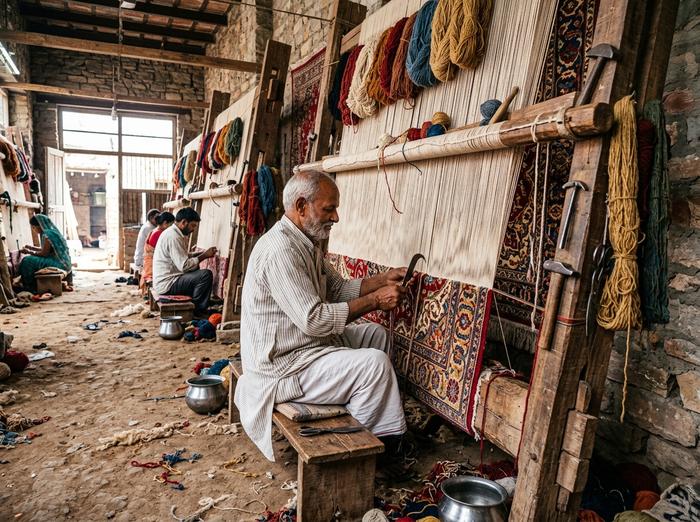
We visit the workshop or weaver, check the loom and the work in progress, and confirm export history before any deposit is paid.
Sample & Approve
A sample or a small piece is checked for KPSI, fibre and dye. You approve it before the full order is knotted.
Inspect & Ship
Each finished carpet inspected piece by piece, then rolled, wrapped and packed for export with supervised loading.
More Pages That Help Your Order
Kashmir carpets sit alongside our other carpet, textile and inspection services.
Carpets & Dhurries
Bhadohi hand-knotted and flatweave carpets
Bhadohi Carpet Agent
Hand-knotted and tufted carpets from Bhadohi looms
Textiles & Fabrics
Block prints, home linen and rugs
Panipat Home Textiles
Rugs, cushion covers and bedding from the City of Weavers
Quality Control
Inspections at every stage, with photo reports before you pay
Supplier Verification
Legal and factory checks before you pay a deposit
Pre-Shipment Inspection
Final inspection before your goods leave India
Buyer Applications
Our Kashmir carpet sourcing serves international buyers across multiple sectors
Retailers & Importers
Hand-knotted carpets for retail, with knot density and fibre verified.
Interior Designers
Silk and wool carpets to your design, size and colour.
Hotels & Hospitality
Durable wool carpets and runners for hotels and resorts.
Galleries & Collectors
Fine silk pieces with GI-tag authenticity confirmed.
E-commerce Sellers
Retail-ready packing and consistent quality for online carpet ranges.
Distributors
Container-load carpets with piece-by-piece inspection.
Kashmir Carpet Sourcing FAQ
What is KPSI, and why does it matter?
KPSI means knots per square inch. It is the standard measure of how fine a hand-knotted carpet is — the more knots per square inch, the finer the detail and the longer the carpet took to knot. A higher KPSI means a higher price, so the count must be real. We count the knots on the back of the carpet, so a "fine" carpet is a measured fact, not a sales claim.
Silk vs wool — which should I buy?
Silk is finer, softer and more expensive, and it takes the brightest dyes — it suits showpiece and low-traffic carpets. Wool is durable, resilient and better for everyday use and high-traffic areas. A silk-wool blend balances the two. We confirm the fibre by check, so you get the fibre you paid for.
How do I know a carpet is really hand-knotted?
Look at the back: a hand-knotted carpet shows the individual knots and the pattern in reverse, while a machine-made carpet has a flat, uniform backing. We check the back, count the knots, and visit the workshop to see the loom and the work in progress — so a machine-made carpet is never sold to you as hand-knotted.
What does the GI tag mean for Kashmir carpets?
The GI (Geographical Indication) tag marks Kashmir hand-knotted carpets as a product tied to this place and its craft tradition. It tells you the carpet comes from the Kashmir cluster, but the tag alone does not prove a piece is well made — that is what our knot count, fibre check and inspection are for. We confirm the GI-tag paperwork for your order.
What is the minimum order, and how long does it take?
Hand-knotted carpets are made to order, and the time depends on the size, the knot density and the design — a fine silk carpet takes far longer than a wool runner. There is no single MOQ or lead time for Kashmir carpets; we confirm both per order, in writing, before you pay a deposit.