Khurja Pottery Sourcing: Ceramic Tableware & Decor from India's Ceramic City
Tableware, planters and decorative ceramics from Khurja's GI-tagged pottery cluster — verified on the ground, tested for food safety, and packed to survive the container
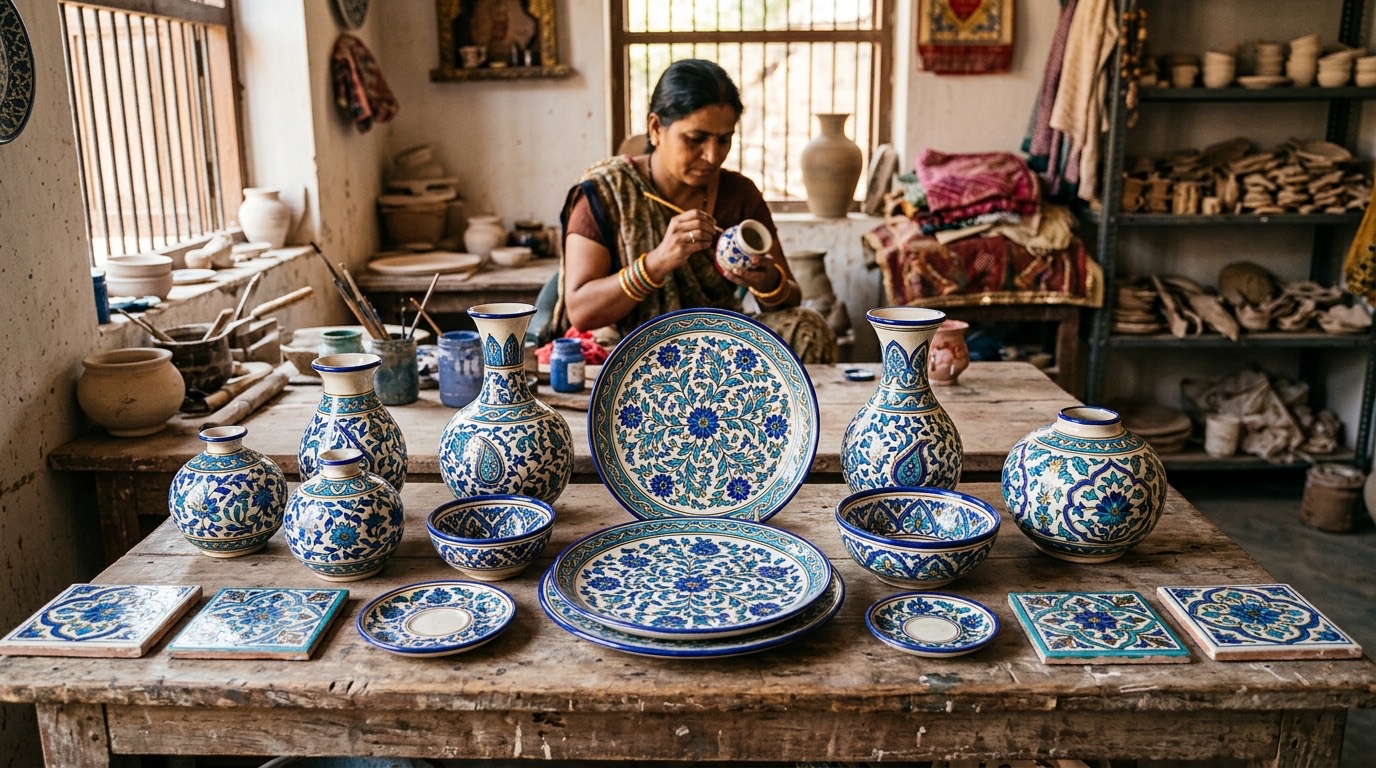
Why Buyers Source Pottery from Khurja
Khurja, in Uttar Pradesh, has made pottery for around 600 years. The town's potters — the Multani Kumhar families who settled here centuries ago — turned a local craft into an export cluster. Today Khurja carries a GI tag for its ceramics, sits under the government's One District One Product programme, and has roughly 800 to 1,000 pottery units shipping to more than 45 countries.
That scale is useful, but it is also where buyers get caught. A trader can show you a sample made in one unit and fill your order from three others. Glaze colour drifts between batches. A mug that looks food-safe may never have been tested for lead or cadmium migration. As your on-the-ground agent in India, we check the unit, the clay, the glaze and the packing before you pay the balance.
- GI-tag cluster, verified on the ground: We visit the unit and confirm it is a maker, not a trader showing someone else's work.
- Glaze & colour consistency: Sample-to-production colour checked against your approved sample, with a clear range for hand-painted variation.
- Food-contact testing: Lead and cadmium migration tested on the finished decorated piece, to the rules of your market (EU 1935/2004, US FDA limits).
- Breakage-tested packing: Individual wraps, dividers and drop-tested cartons — and a breakage review after your trial shipment.
- Mold ownership: Your shapes and decals stay yours; we confirm who owns the molds before production starts.
What We Source from Khurja
Khurja Pottery Quality Checks
Pottery fails in specific ways — here's what we verify before your container ships
Clay Body
Earthenware, stoneware or porcelain? We confirm the body matches your spec and check water absorption, so a "stoneware" mug is not earthenware in disguise.
Glaze & Colour
Hand-painted pieces vary. We set the acceptable range with you and check each batch against the approved sample, so the second container matches the first.
Food-Contact Testing
Lead and cadmium migration tested on the finished, decorated article — not on a blank test tile. Dishwasher, microwave and oven claims are checked one by one, never assumed.
Wobble, Crazing & Handles
Every piece checked for a flat base, hairline crazing, handle strength and chipped rims before packing.
Batch Consistency
Samples compared across units and batches, so colour, size and finish stay steady across repeat orders.
Packing & Breakage
Individual wrapping, dividers, stacking and pallet rules checked, with a breakage review after the trial shipment built into your landed cost.
Our Khurja Pottery Sourcing Process
Send Your Brief
Product, shape, glaze, quantity and target price. We tell you what Khurja can and cannot make for that brief — and what to buy elsewhere.
We Verify the Unit
We visit the workshop, check the kiln and firing, and confirm mold ownership and batch traceability before any deposit is paid.
Sample & Test
Samples made to your spec, then tested for food contact, wobble, crazing and handle strength. You approve the sample before bulk production.
Inspect & Load
Pre-shipment inspection of the packed goods, then supervised container loading with sealed documentation.
More Pages That Help Your Order
Khurja pottery sits alongside our other sourcing and inspection services — use them together for a complete order.
Pottery & Ceramics
Blue pottery, terracotta and ceramic tableware from Jaipur and Khurja
Home Decor
Decor, lighting and accent pieces from India's craft hubs
Handicrafts
Brassware, wood carvings, blue pottery and home decor
Quality Control
Inspections at every stage, with photo reports before you pay
Supplier Verification
Legal and factory checks before you pay a deposit
Factory Audit
Capacity and compliance evaluation on site
Pre-Shipment Inspection
Final inspection before your goods leave India
Buyer Applications
Our Khurja pottery sourcing serves international buyers across multiple sectors
Retailers & Importers
Tableware and decor ranges for retail, with consistent glaze and packing.
Hotels & Restaurants
Durable tableware in your glaze and logo, checked for chipping and food safety.
E-commerce Sellers
Retail-ready packing and consistent colour across repeat orders.
Gift & Homeware Brands
Decorative ceramics and gift sets, private label with your design.
Interior Designers
Tiles, vases and planters to your spec, in the glaze you approved.
Distributors
Container-load tableware with batch consistency and breakage-tested packing.
Khurja Pottery Sourcing FAQ
What does the GI tag mean for Khurja pottery?
The GI (Geographical Indication) tag marks Khurja ceramics as a product tied to this place and its craft tradition. It tells you the pottery comes from the Khurja cluster, but it does not by itself prove a piece is food-safe or well made — that is what our testing and inspection are for.
Stoneware vs porcelain — which should I order?
Stoneware is the workhorse of Khurja: dense, durable and good for everyday tableware. Porcelain is finer and more expensive, and true porcelain is rare in Khurja. Earthenware is porous and best kept to decor. We confirm the clay body on your sample before you commit, so you are not sold earthenware as stoneware.
Is Khurja pottery food-safe?
It can be, but only when tested. We test lead and cadmium migration on the finished, decorated piece to the rules of your market — EU Regulation 1935/2004 for Europe, FDA limits for the US. A glaze that is safe on a blank tile is not automatically safe once decoration is added. Decor pieces that are not food-safe must never carry food-use imagery.
What is the minimum order?
There is no single MOQ for Khurja. It depends on the glaze and the shape: a standard glaze in a standard shape can run in a smaller batch, while a custom colour or a new mold needs a larger run to cover tooling. We get you the MOQ per glaze and per shape in writing before you place an order.
How much breakage should I expect, and how long does an order take?
Breakage depends on packing, not luck. With individual wrapping, dividers and drop-tested cartons, breakage stays low — but we build a breakage provision into your landed cost and review it after your trial shipment. Lead time depends on whether the shape is ready stock or made to order, and on the glaze; we confirm the timeline per order before you pay a deposit.