If you source solid wood furniture from Jodhpur, handwoven rugs from Bhadohi, or brass decor from Moradabad, sooner or later you will get this email: "Sir, due to unavoidable circumstances, your container shipment will be delayed by another 3 to 4 weeks."
For overseas importers with retail marketing calendars, seasonal product launches, or tight distributor contracts, unexpected manufacturing delays destroy profitability. Shipping container bookings expire, demurrage fees loom, and customer goodwill evaporates.
However, panicking or sending threatening legal emails from 6,000 miles away rarely speeds up a production line. In fact, aggressive threats often lead defensive suppliers to ghost communications or rush defective goods through finishing booths. Here is a practical, on-the-ground playbook for diagnosing the real cause of the delay, regaining commercial control, and getting your shipment moving.
1. Find the Real Cause (Not the Polite Excuse)
Indian business culture often places high value on maintaining harmony and avoiding immediate conflict. So factory managers frequently withhold bad news until the original shipping cutoff has already passed, offering generic excuses like "raw material shortage" or "unprecedented heavy rains."
To fix the delay, you must uncover the actual operational bottleneck:
| The Factory's Excuse | The Ground Reality | Real Corrective Action |
|---|---|---|
| "Raw material wood is still seasoning" | The factory delayed purchasing timber until timber prices dropped, or their vacuum kiln was filled with higher-margin domestic orders. | Demand an immediate video walkthrough of the kiln batch with pin moisture meter readings logged per lot. |
| "Labor shortage after festival" | Migrant artisans returned to agricultural villages for sowing/harvesting (e.g., during Holi, Diwali, or monsoon sowing), leaving skeleton crews. | Establish whether sub-assembly can be shifted to day/night double shifts or outsourced to pre-audited secondary workshops. |
| "Finishing spray paint is drying slowly" | High humidity during monsoon (July–September) creates blushing in NC/PU lacquers; without heated curing rooms, drying takes 3x longer. | Inspect curing chamber temperatures; switch temporarily to water-based fast-cure sealers or infrared drying lamps. |
| "Hardware accessories delayed by sub-vendor" | Factory placed custom metal casting or hinge orders late without monitoring sub-supplier lead times. | Step in to authorize standard in-stock export hardware specifications to prevent halting the entire carpentry line. |
2. Get Eyes on the Factory Floor (Stop Relying on WhatsApp Photos)
When a supplier is behind schedule, photographic updates sent via WhatsApp or email can be misleading. Factories often photograph the same 5 completed sample units from different angles or display stock belonging to another buyer.
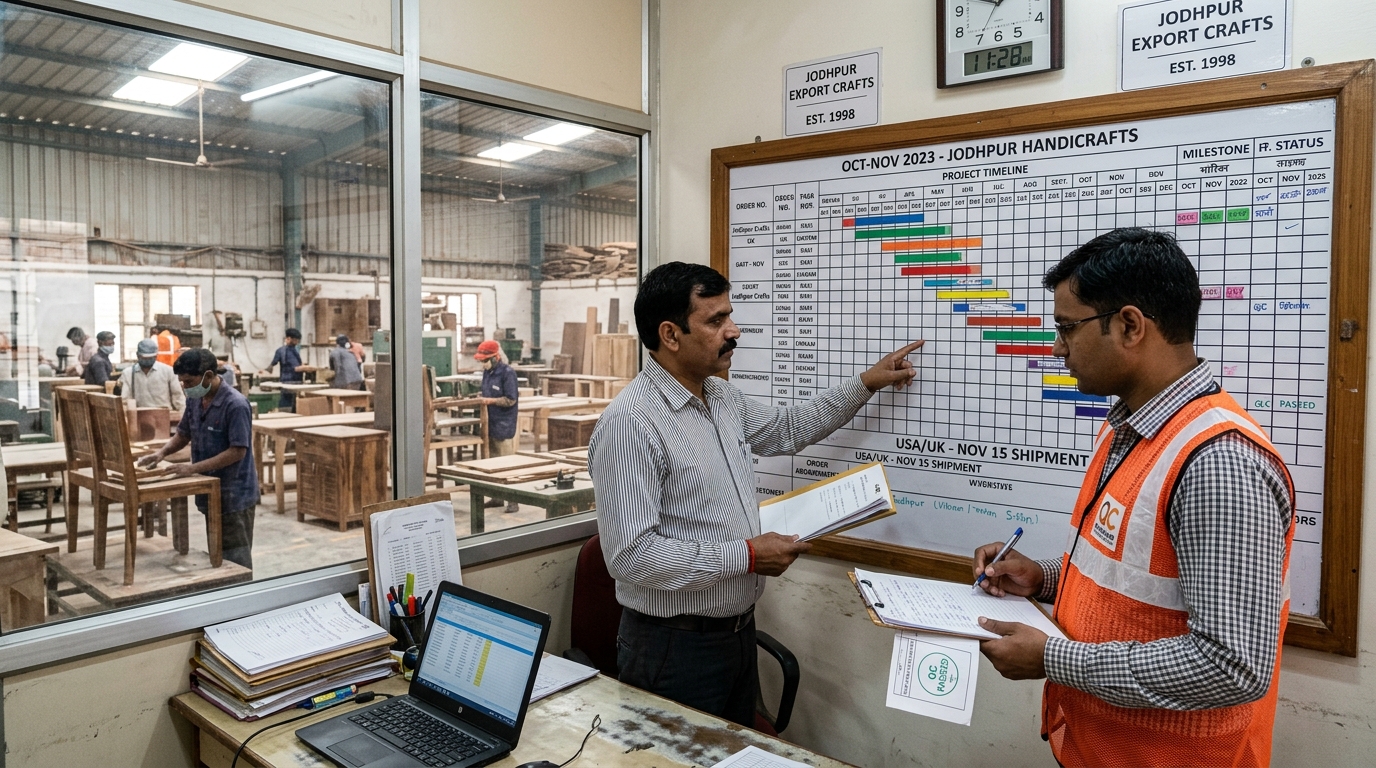
You need an immediate During Production (DUPRO) Inspection. Having an independent sourcing agent or local QC inspector physically enter the workshop achieves two critical goals:
- Physical WIP Count: Counting exact units in raw cutting, joinery, sanding, finishing, and final packing stages gives you the real completion percentage.
- Psychological Urgency: Indian factory proprietors prioritize orders where the overseas client has physical feet on the factory floor. When our inspectors arrive at an industrial unit in Basni or Boranada (Jodhpur), factory owners immediately redirect their skilled carpenters to that specific line.
3. Use Commercial Leverage That Actually Works
Threatening international arbitration or court action under the Indian Arbitration and Conciliation Act is practically ineffective for short-term delays—litigation in India takes years. Instead, rely on commercial leverage:
A. Split Shipments (LCL Air/Sea + FCL Bulk)
If your retail launch or customer commitments require immediate stock, negotiate a split shipment:
- Require the supplier to finish and air-freight 10% to 15% of the most critical SKUs at their expense (or shared air courier expense).
- Ship the balance 85% via ocean freight as soon as the full container load (FCL) reaches 100% completion.
B. Re-Tying the 70% Balance Payment
Never release your balance payment (one common structure is the balance against Bill of Lading scan) until a comprehensive Pre-Shipment Inspection (PSI) has passed. If the factory demands an advance payment concession to "buy packaging cartons" or "pay workers overtime," decline firmly unless backed by physical inventory ownership.
4. Prevent Delays on Your Next Orders
Once you recover the current order, restructure your operational protocols for future runs:
- Establish 30-60-90% Milestone Sign-Offs: Break your PO schedule into three distinct checkpoints: 30% (raw material in-house and seasoned), 60% (carpentry/machining assembled), and 90% (finishing applied, ready for packaging).
- Buffer Seasonal Production Windows: Build a 3-week buffer into orders placed between October and November (Diwali shutdowns) and July through August (monsoon wood seasoning delays).
- Audit Machine Capacity in Advance: Before issuing a 5-container PO, conduct a formal factory audit to confirm the unit's monthly kiln throughput and worker headcount.
Stuck with a Delayed Container in Rajasthan?
Our on-the-ground inspection team in Jodhpur and Jaipur can visit your supplier's factory floor within 24 to 48 hours to audit actual work-in-progress, verify timber moisture, and provide a realistic completion date. Request an On-Site Factory Visit →