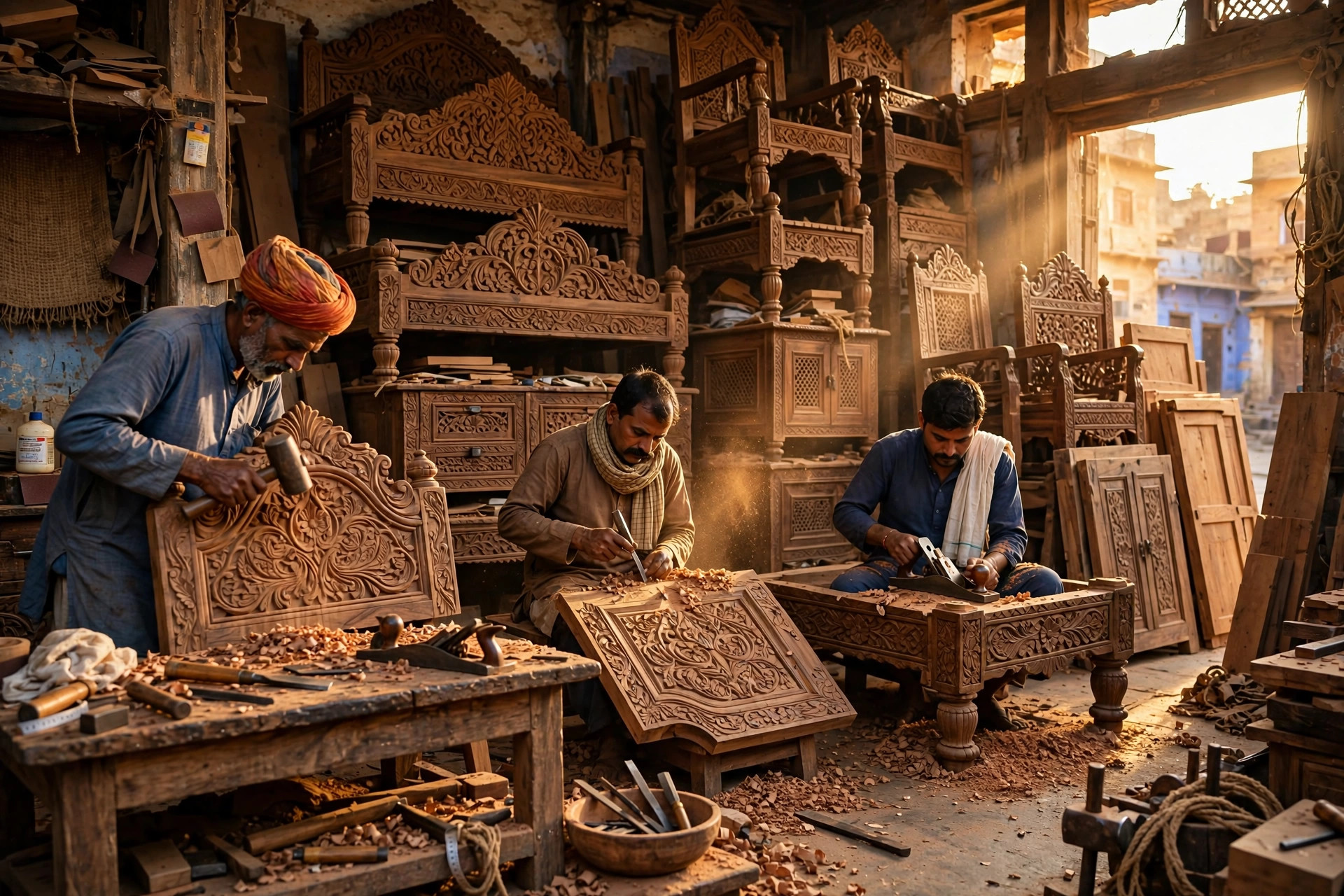
Jodhpur's workshops ship carved sheesham dining sets, bone-inlay cabinets, and rustic mango-wood beds to retailers in more than forty countries. Yet plenty of containers arrive the other way — warped tabletops, borer holes, finish defects that quietly eat the importer's entire margin. In most cases, that is not bad luck. It is a skipped step somewhere in the process. This guide walks you through sourcing wooden furniture from Jodhpur the way experienced buying offices do it: vetting the factory, locking the timber specification, approving samples properly, and supervising inspection and loading.
1. Why Jodhpur Leads India's Wooden Furniture Exports
Jodhpur is India's largest wooden furniture export cluster, with hundreds of manufacturing units spread across industrial areas like Basni and Boranada, plus thousands of artisan workshops in the old city. The cluster grew around sheesham (Indian rosewood) carving traditions that go back generations, and today it produces everything from ornate hand-carved beds to clean-lined Scandinavian-style mango wood collections for European retailers.
Buyers keep coming back for three practical reasons. The craftsmanship genuinely scales: hand carving, bone inlay, and distressed finishes that machines cannot copy at a sensible cost. Timber is close at hand: Rajasthan's dry climate and long-established seasoning yards keep properly dried sheesham, mango, and acacia available all year. And the export route is straightforward: Jodhpur's inland container depot connects to Mundra and Nhava Sheva ports, so a 40ft box can be stuffed at the factory gate and sealed for the whole journey.
On price, Jodhpur sits in a useful middle: above mass-produced budget lines, well below premium European joinery. Handmade solid-wood pieces that still leave a healthy retail margin. That middle ground is a big reason the cluster keeps picking up orders from buyers moving away from single-country supply chains.
2. Step 1 — Vet the Factory Before Paying Any Deposit
Most sourcing failures in Jodhpur trace back to one mistake: wiring a 30% advance to a "manufacturer" who turns out to be a trading middleman with no workshop. Before any money moves, verify the fundamentals. A genuine export factory will share its GSTIN registration, Import-Export Code (IEC), and pollution board clearances without hesitation — reluctance here is a red flag.
- Export track record: ask for bills of lading or references from buyers in your region, not just photos of finished goods.
- Real capacity: a unit claiming five containers a month should have the carpenters, seasoning sheds, and finishing booths to prove it. A video walkthrough of the shop floor tells you more than a brochure.
- Factory vs. trader: traders add 12–20% and cannot control quality on the shop floor. Insist on dealing with the unit that actually cuts the wood.
- Compliance basics: fire safety, worker welfare registrations, and proper timber sourcing documentation — increasingly important for EU and US buyers facing supply-chain due-diligence rules.
Payment terms deserve the same scrutiny as the factory itself. The Jodhpur standard is 30% advance with the balance against shipping documents, but never wire the advance to a personal account — always to the company's current account matching the GSTIN name. For first orders above $25,000, consider a 30/70 split with the final 70% released only after your pre-shipment inspection passes. Escrow or LC terms are rare at this cluster's price points, so the inspection gate is your real financial protection.
If you cannot visit in person, a professional supplier verification visit by a local team pays for itself many times over. A written verification report documents what the inspector did and did not find on site, which gives buyers leverage in deposit disputes. Sourcing partners on the ground in Rajasthan can complete these checks in days, not weeks.
3. Step 2 — Lock the Timber Spec: Wood, Moisture, and Joinery
Furniture disputes almost always come down to timber. Get the specification in writing before production starts: exact wood species, seasoning method, target moisture content, joinery type, and finish schedule. Verbal agreements on "seasoned sheesham" mean nothing when a container arrives warped.
| Timber | Typical Use | Moisture Target | Price Band | Key Watch-outs |
|---|---|---|---|---|
| Sheesham (Indian rosewood) | Carved beds, dining sets, cabinets | 10–12% | $$$ | Fake "sheesham finish" on cheaper woods — insist on a species declaration |
| Mango wood | Scandinavian-style, painted, rustic lines | 10–12% | $$ | Softer timber — check screw-holding strength on joints |
| Acacia | Live-edge tables, hard-wearing lines | 10–12% | $$ | High tannin content — confirm finish compatibility first |
| Reclaimed wood | Vintage / industrial collections | 8–10% | $$$ | Hidden nails and borer history — demand metal detection and fumigation certificates |
Ask any inspector what ruins the most shipments and you will hear the same answer: moisture. Wood at 16–18% moisture shrinks, cracks, and warps once it acclimatises to a heated European home or an air-conditioned US store. Insist on kiln-seasoned stock with a documented 10–12% reading at pre-shipment stage — taken with a calibrated pin meter, not by knocking on the board and guessing.
Joinery deserves the same attention. Mortise-and-tenon joints with proper glue outperform dowels and screws on heavy pieces. Ask for a cutaway or joint sample alongside your golden sample so there is no ambiguity about what "solid wood construction" means in your purchase order.
4. Step 3 — Approve Samples the Way Inspectors Do
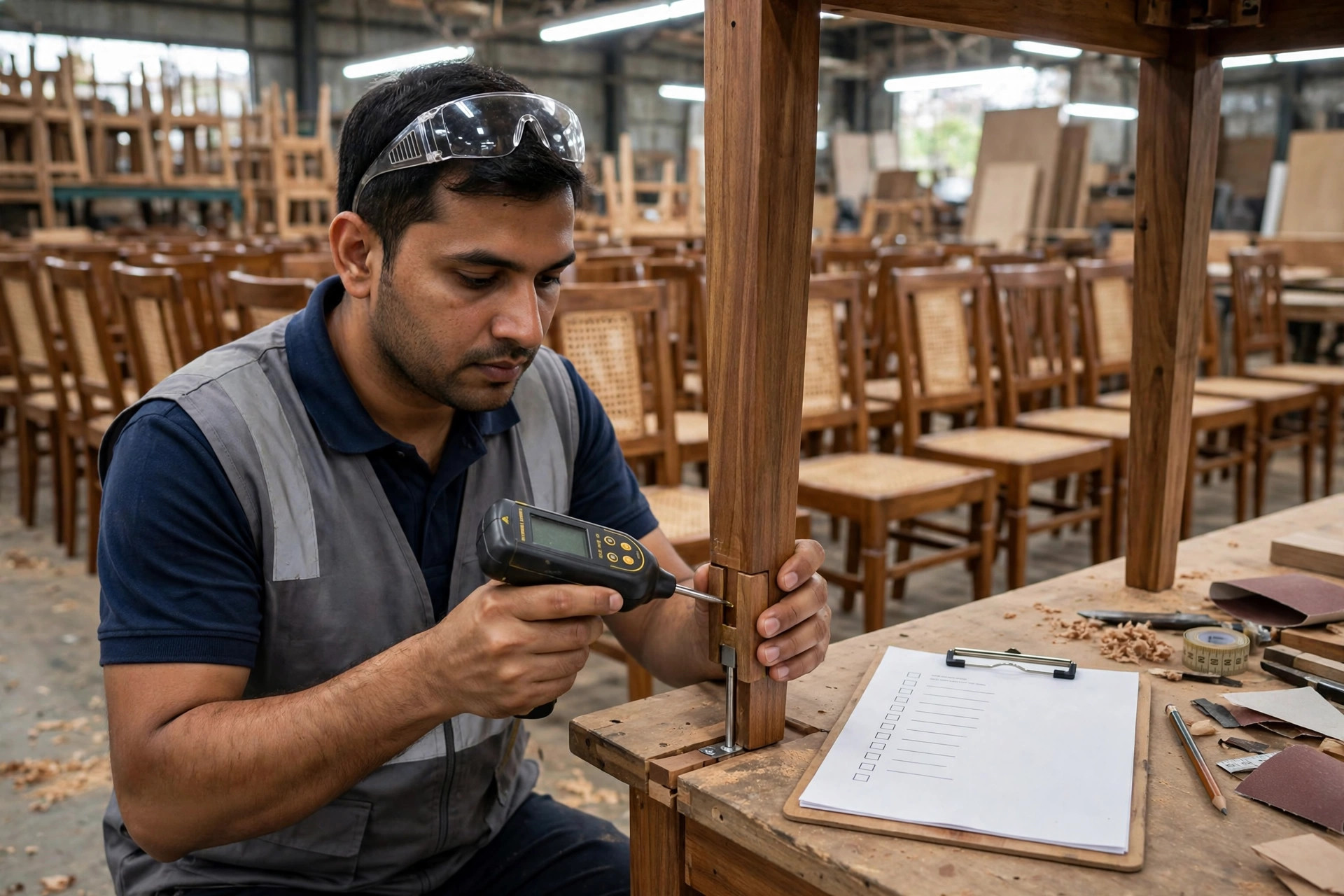
Never approve production from photos alone. The golden sample process has three stages: first, a raw timber sample to confirm species; second, an unfinished (white-wood) sample to check joinery and dimensions; third, a fully finished sample in your exact stain and hardware. Each stage gets a signed approval with dated photos.
Measure everything against your tech pack: overall dimensions (±3mm tolerance on case goods), drawer slide action, door gaps, finish adhesion (cross-hatch test), and colour consistency under daylight. Record the approved sample's weight too — a sudden weight drop in production often means thinner sections or substituted timber.
Keep one sealed golden sample with your quality control team and leave its twin at the factory. Every inspection references the same physical standard, which removes 90% of "but we thought you meant..." arguments.
5. Step 4 — Supervise Production and Book a Pre-Shipment Inspection
A during-production (DUPRO) check at 20–30% completion catches systemic issues — wrong stain batch, undersized panels, skipped sanding — while there is still time to correct them without delaying shipment. Waiting until the goods are packed is the most expensive time to discover a problem.
The pre-shipment inspection is your last gate before the balance payment. A proper PSI covers AQL sampling across cartons, moisture readings on multiple pieces, function tests on every moving part, finish and colour checks against the golden sample, and carton and packing verification. Anything above your agreed AQL defect limit gets reworked or rejected before loading — not debated after arrival.
6. Step 5 — Export Packing and Container Loading Done Right

Furniture damage in transit is a packing failure, not a shipping failure. Export packing for Jodhpur furniture should mean: foam edge protectors on all corners, bubble wrap on carved surfaces, 5-ply or 7-ply cartons (never 3-ply for sea freight), and silica gel sachets inside sealed poly for the four-to-six-week voyage. For high-value carved pieces, wooden crates are worth the CBM cost.
Supervised container loading protects both the goods and your freight budget. Inspectors check carton count against the packing list, photograph the loading sequence, verify weight distribution, and record the container seal number. Poor loading — heavy pieces stacked on top, dead air space, unbraced cartons — is how containers arrive with crushed corners and how buyers end up paying to ship empty space.
One compliance detail buyers often miss: any solid-wood packing material — crates, pallets, dunnage — must be ISPM-15 heat-treated and stamped, or customs at the destination port can hold or destroy the shipment. Reputable Jodhpur exporters handle this routinely, but confirm the stamp requirement is written into your packing specification rather than assumed.
As a rule of thumb, a 40ft high-cube fits roughly 55–65 CBM of knock-down or well-nested Jodhpur furniture. If your forwarder quotes far less usable space, the packing plan — not the container — is usually the problem.
The Bottom Line on Jodhpur Furniture
Genuinely handmade solid-wood pieces at commercial prices, with a supply chain you can trace from timber yard to container seal. Work through the five steps above — verify the factory, lock the timber spec, approve samples properly, inspect before shipment, supervise the loading — and buying from India stops feeling like a gamble and starts feeling like a process. Explore Our Furniture Sourcing Services →