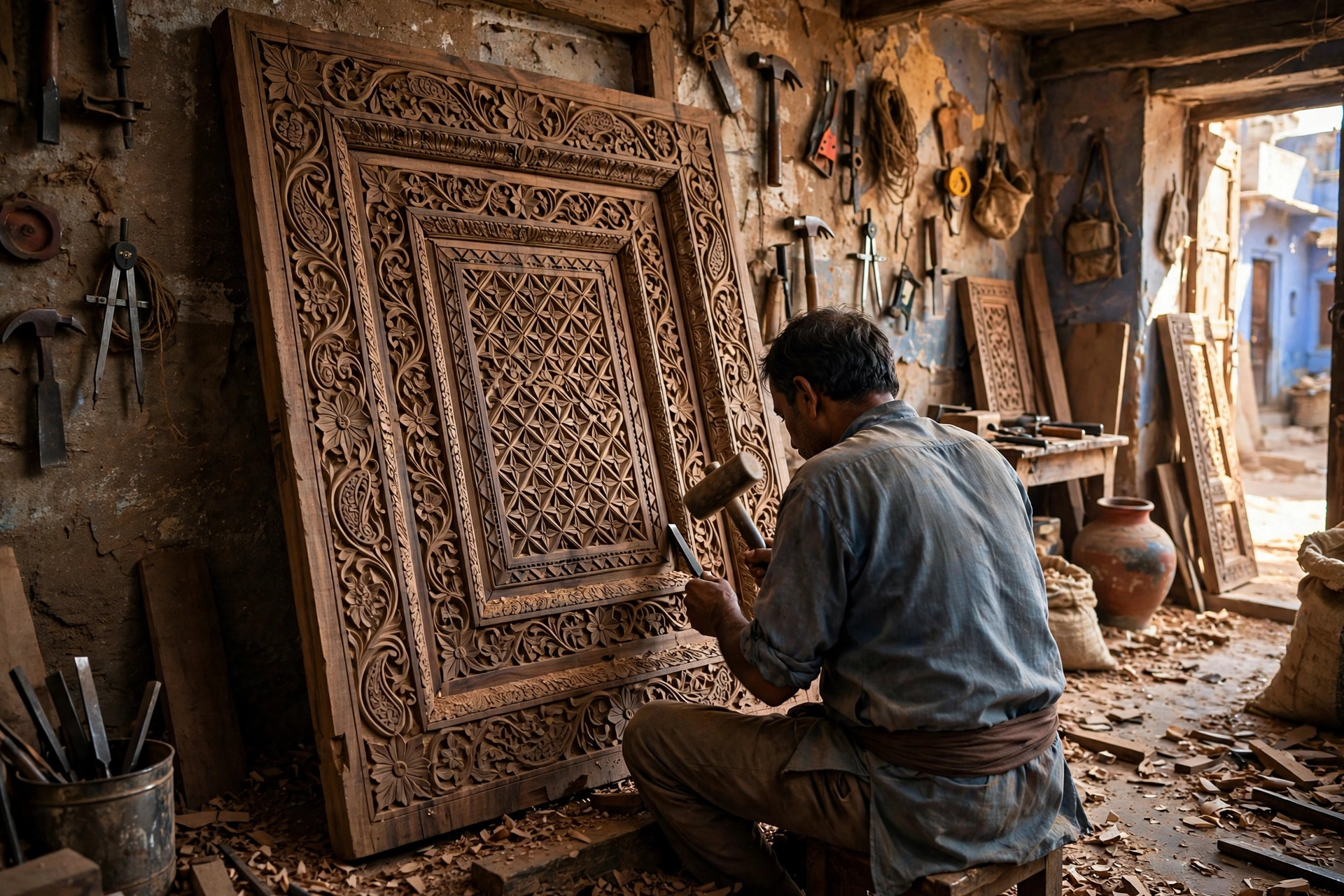
A hand-carved Rajasthani door is one of the hardest products in the home-decor trade to buy well. Every piece is a one-off: different timber, different carving depth, different moisture history. Retailers across the US, UK, and Europe sell them as statement pieces — entryways, restaurant fit-outs, boutique hotel lobbies — and the margins are strong when the piece arrives straight and true. When it arrives warped or cracked, there is no fixing it on the other side. This guide covers how experienced buyers source carved doors and architectural elements from Rajasthan: what the workshops make, how to separate new carving from reclaimed stock, what to put in writing, and how to inspect and pack pieces that are expensive to get wrong.
1. What Rajasthan's Workshops Actually Make
The carving trade centres on Jodhpur and spreads through the Shekhawati belt, where demolished havelis feed the reclaimed market. Workshops produce carved doors (single and double), door frames, shutters, jharokha-style arches, wall panels, corbels, pillars, and headboards that are really door panels repurposed. Most genuine carving still happens in small old-city workshops, where a master carver and two apprentices turn out a handful of doors a month.
The buyer base splits three ways. Home-decor retailers take carved doors as floor stock or convert them into tables and bar fronts. Hospitality groups order matched sets for fit-outs. Salvage dealers buy reclaimed pieces by the truckload and sort them later. Knowing which of these you are matters — the workshop that serves a salvage dealer will not suit a 200-piece hospitality order.
2. New Carved vs Reclaimed: Two Different Businesses
The single most important decision is whether you want new carving or reclaimed stock. They are different products, made by different workshops, bought on different terms.
New carved doors are made to your drawing. You choose the timber, the carving pattern, the size, and the finish, and the workshop builds to it. Sizes come out consistent, which matters if you are selling pairs or fitting frames into a construction schedule. The trade-off is lead time — a carved double door takes a master carver several weeks — and the fact that you are buying sight unseen until the first sample is finished.
Reclaimed doors come from demolished havelis and old houses across Rajasthan and Gujarat. The timber is old-growth — denser and more stable than anything you can buy new — and the patina is impossible to fake convincingly. But every piece is irregular: sizes vary, old hardware holes need filling, and some pieces carry borer history. Genuinely antique pieces (a century or more old) fall under India's export controls, so get the paperwork question answered before you fall in love with a piece.
| Category | What You Get | Lead Time | Main Risk |
|---|---|---|---|
| New carved doors | Made to your design, consistent sizes, your choice of timber and finish | 45–60 days after sample approval | Machine-assisted carving sold as hand work; moisture if timber is rushed |
| Reclaimed doors | Old-growth timber, genuine patina, each piece unique | Immediate, but hunting the right pieces takes time | Active borers, hidden cracks, irregular sizes, export documentation |
| Architectural salvage panels | Carved panels, brackets, arches — sold loose for repurposing | Immediate for stock; 3–4 weeks for sorted lots | Condition varies piece to piece; grading is subjective |
Many buyers run both streams: new carved doors for the repeatable retail line, reclaimed pieces for one-off showroom stock. Don't mix the two in one purchase order — the inspection criteria are completely different.
3. Specifying the Work: Timber, Carving, and Finish
For new carved doors, the written specification is everything. Start with timber. Sheesham (Indian rosewood) is the traditional choice for fine carving — dense, holds detail, finishes well. Mango wood carves easily and costs less, but it is softer and dents on the high points of deep carving. Old teak appears in the reclaimed trade and is superb when you find it. Whatever you choose, put the species name in the purchase order and target 10–12% moisture, measured with a pin meter at inspection.
Specify carving depth in writing (shallow relief at 8–10mm reads flat in a showroom; deep carving at 20mm and beyond is what sells the piece), and ask how the rough work is done. Most of Jodhpur roughs out with a router and finishes by hand — nothing wrong with that, but it should be priced accordingly. Genuine hand carving shows chisel facets and slight asymmetry; fully machine work repeats every pattern identically.
Dimensions cause more arguments than any other topic. Indian workshops think in feet and inches; your warehouse thinks in millimetres. Write both on every drawing, and confirm the overall size, the stile and rail widths, and the panel thickness. Hardware is the next trap: iron studs, ring handles, and hinges are often priced separately, so state clearly whether your price includes them fitted. On finish, approve a physical sample before production starts — oil and wax gives the warm Rajasthani look; PU is tougher but can look plasticky on deep carving.
4. The Quality Checkpoints That Matter for Doors
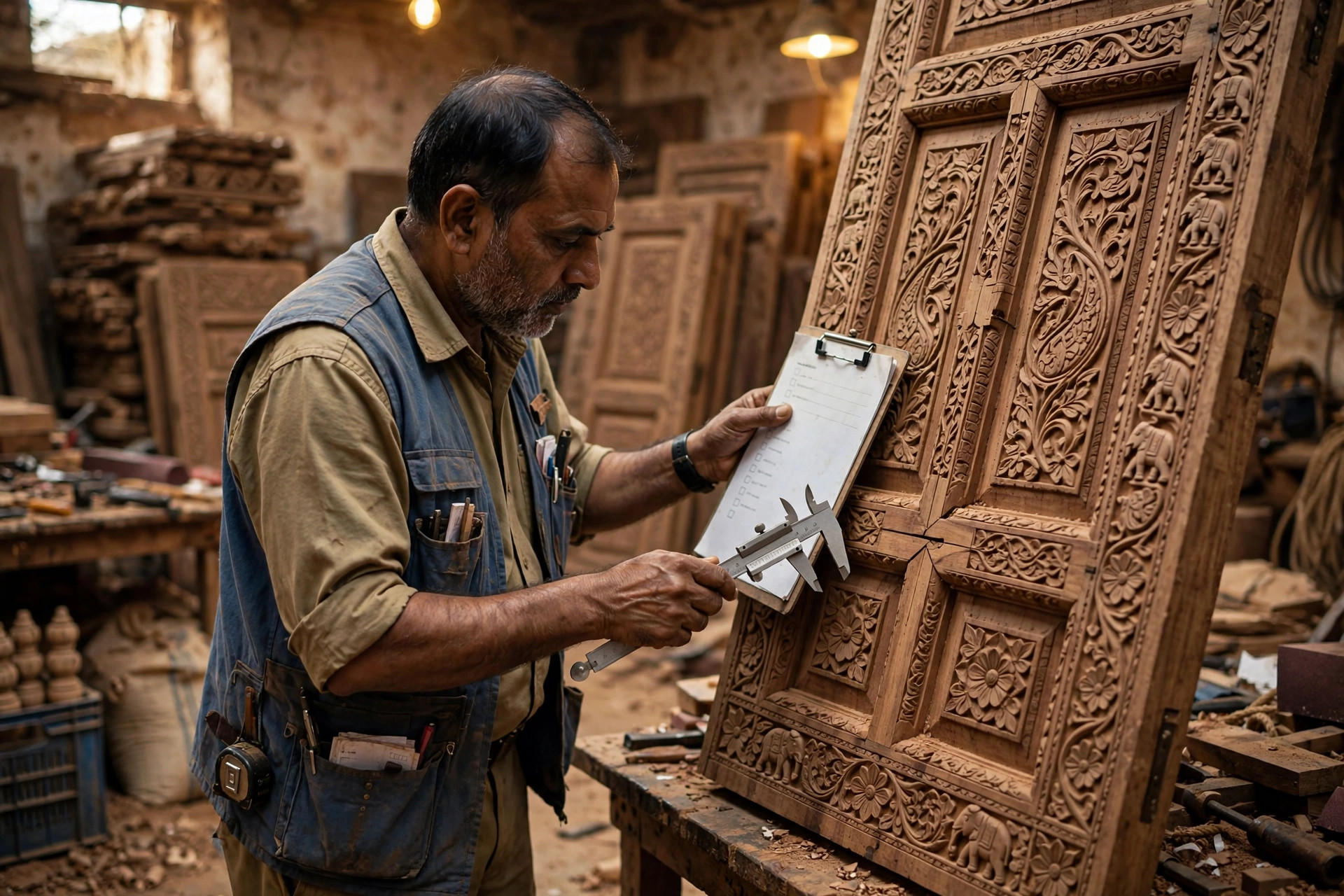
Check flatness first: stand the door on its long edge and sight along it, then lay a straightedge across the face. Next, moisture — pin meter, multiple points, both faces. For reclaimed pieces, check every borer hole for fresh dust; old holes are character, fresh dust means live insects and the piece needs fumigation before it goes anywhere near your container.
Then the carving itself. Compare each door against the approved sample: pattern match, depth, and edge finishing. On pairs, hold the two doors side by side — asymmetry between supposedly matched doors is the most common complaint we see. Run a torch at a low angle across the face to catch filler; workshops sometimes fill cracks with tinted putty that reads fine in daylight and fails within a year. Test finish adhesion with a cross-hatch check on an inconspicuous edge. A proper pre-shipment inspection catches all of this before the doors leave the workshop — once they are crated, you are buying blind.
5. Packing and Shipping: Doors Are Awkward Freight
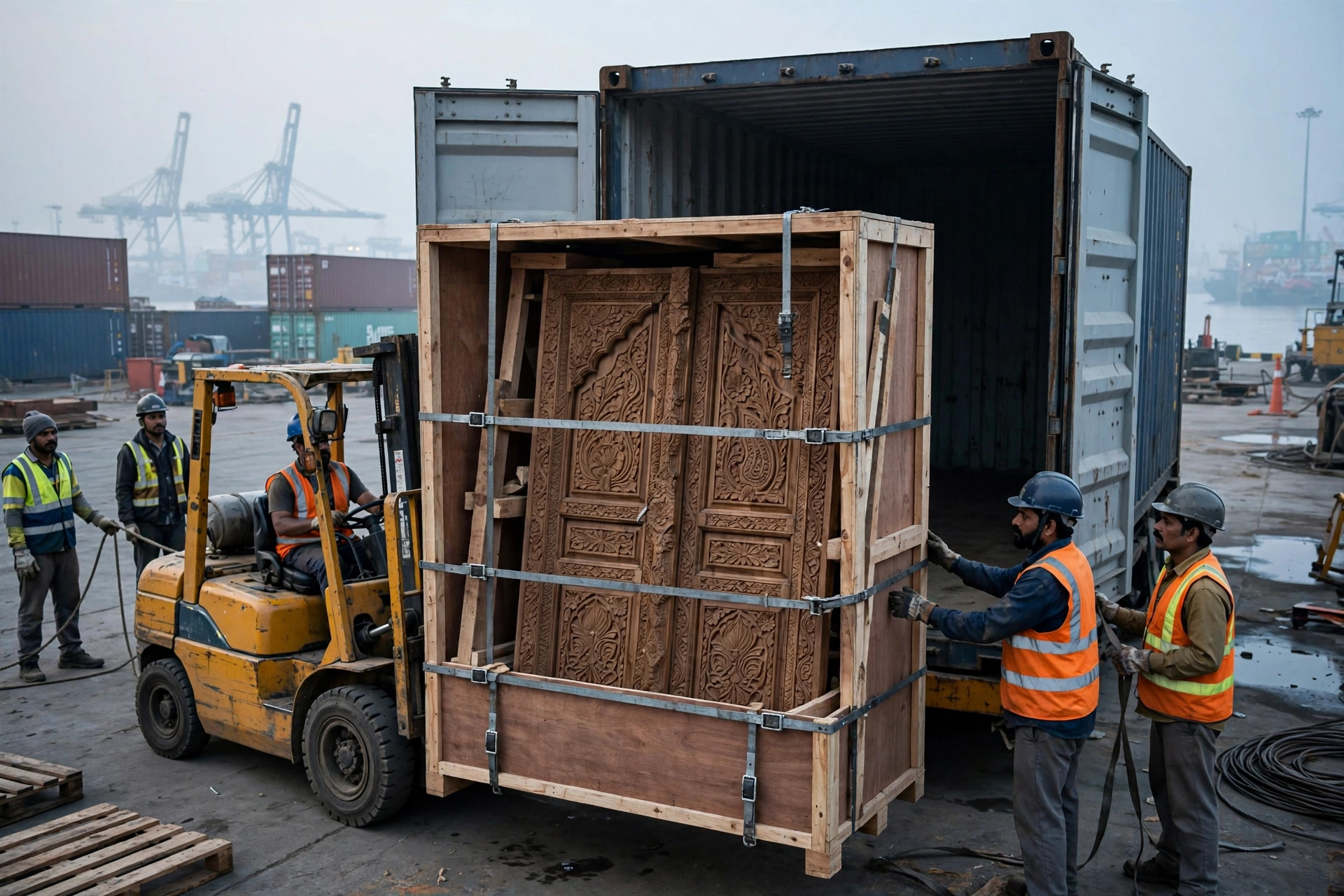
Doors are tall, heavy, and top-heavy — the worst combination for sea freight. They must travel upright in A-frame plywood crates, never flat-stacked, with the carved face protected by foam sheet and the corners guarded by timber corner boards. The crate timber must be ISPM#15 heat-treated with the stamp visible; port inspectors will hold a container over an unstamped pallet. Put silica gel inside each crate — a sealed container crossing the equator sweats, and surface mould on a carved door is a customer complaint you cannot talk your way out of.
Damage happens at the same points every time: the bottom corners during forklift handling, and the high points of deep carving where another crate leans in. Strap the crates, brace them against the container walls, and photograph the loading. Carved doors are high-value, low-weight cargo, so declare the real value on your marine insurance. Buyers usually mix doors with panels and corbels to fill a container well: heavy doors low and central, lighter panels above.
6. Working with a Jodhpur-Based Sourcing Partner
The best carving workshops in Jodhpur do not have websites. They have a mobile number, a workshop full of shavings, and a waiting list. Finding them, checking they actually carve what they show you, consolidating output from three or four small units into one container, and supervising the packing — that is a full-time job on the ground. A Jodhpur-based sourcing partner does the unglamorous parts: verifying the workshop, locking the spec in writing, running sample approvals, and standing at the container during loading. If carved doors are part of a wider furniture sourcing programme from Rajasthan, that local presence is the difference between opening a container with confidence and opening it holding your breath.
Frequently Asked Questions
What is the minimum order quantity for hand-carved doors from Rajasthan?
For new carved doors, most Jodhpur workshops accept orders of 10–20 pieces per design, and many will mix designs in a single container. Reclaimed doors are sold piece by piece, so the MOQ is really about filling a container sensibly — buyers commonly top up door orders with panels, corbels, and smaller carved items.
How long does production and shipping take?
New carved doors run 45–60 days of production after sample approval, plus inland transport to Mundra or Nhava Sheva and 25–35 days of sea freight to Europe or the US East Coast — plan on 90–110 days door to door. Reclaimed pieces ship as soon as they are selected, fumigated, and packed. Build in buffer around Diwali, when workshops close for one to two weeks.
How can I tell if a door is genuinely hand-carved?
Look at the back of the panel and the deep cuts: hand work leaves chisel facets and slight irregularities, while machine carving repeats patterns with perfect uniformity. Check that supposedly matched pairs are not identical down to the millimetre — real hand carving always varies slightly. Ask the workshop directly how the rough work is done; the honest ones will tell you.
Can I export genuine antique doors from India?
Items certified as over 100 years old fall under India's antiquities export controls and need proper clearances before shipment. Most of what the trade calls "antique" is actually vintage or reclaimed — old, but not legally antique. Ask your supplier for written confirmation of the piece's status and get the export documentation sorted before the container is booked, not after.

Published by QualityLink Global Sourcing Team
Operating directly out of Jodhpur and Jaipur, Rajasthan. Our team provides hands-on supplier verification, factory audits, moisture testing, quality control, and container loading supervision across North India.
Need On-the-Ground Sourcing or QC Support in India?
If you have a prospective supplier in Rajasthan or North India, an active production run, or upcoming container loading, we can step onto the factory floor to verify specs and eliminate export risks.