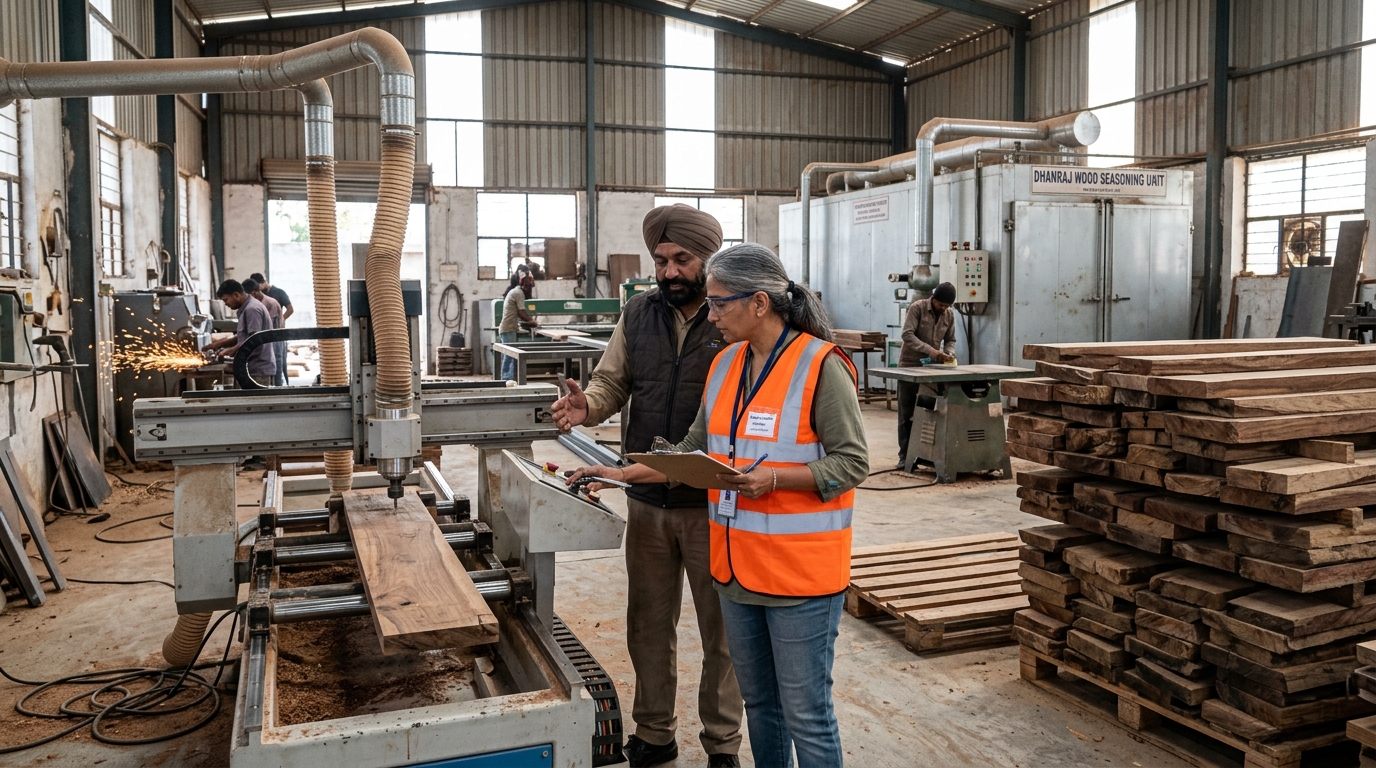
If you source products on Alibaba, IndiaMART, or meet vendors at export exhibitions in Delhi or Greater Noida, almost every contact will introduce themselves as a "direct manufacturer with integrated manufacturing infrastructure."
In reality, a significant portion of registered export businesses across North India are merchant exporters, commission agents, or trading intermediaries. While there is nothing inherently wrong with trading companies—many provide valuable consolidation and local communication—the problem arises when a broker pretends to be a primary factory. When you believe you are negotiating directly with the factory owner, but your orders are quietly subcontracted to third-party cottage units, you face unexpected price markups (often 15% to 35%), rolling production delays, and zero direct quality control over the shop floor.
Here is how experienced international buyers verify whether an Indian supplier actually owns and operates a physical manufacturing unit, from remote documentary cross-checks to on-the-ground factory floor audits.
1. The Commercial Distinction: Why It Matters for Importers
Understanding why intermediaries misrepresent their operations helps you spot red flags early:
- Price Transparency: An intermediary must build their operating margin into your quoted FOB rate while still trying to appear competitive. To protect their margin, they will inevitably squeeze the true artisan workshop, leading the maker to cut corners on timber seasoning, coating thickness, or packaging strength.
- Subcontracting Chains: A true manufacturer controls their machine schedule, kiln cycles, and shift workers. A trading firm places your purchase order with an independent workshop. If that workshop receives a larger domestic order or runs into labor shortages, your export container gets delayed without warning.
- Quality Control Accountability: When defective goods fail an AQL inspection, a true factory owner can command their carpentry or finishing team to rework the batch. A middleman has little leverage over an independent contractor once advance deposits have been passed downstream.
2. Remote Verification: The Documents That Reveal the Truth
Before booking flights or hiring local inspectors, you can uncover critical facts using public government registries in India:
A. Decoding the 15-Digit GSTIN Structure
Every legitimate tax-paying business in India has a Goods and Services Tax Identification Number (GSTIN). The 15-character code contains vital intelligence:
- First 2 digits: State Code (e.g.,
08for Rajasthan,09for Uttar Pradesh,07for Delhi). If a vendor claims their furniture factory is in Jodhpur, Rajasthan, but their GSTIN begins with07(Delhi), their corporate billing entity is hundreds of kilometers away from the production hub. - Next 10 digits: The entity's Permanent Account Number (PAN). The 4th letter indicates legal constitution:
Cstands for Company (Private Limited),Pfor Proprietorship,Ffor Partnership, andTfor Trust. - Check the GST Portal: Search the number on the official Indian GST portal (services.gst.gov.in). Look under "Nature of Core Business Activity." It explicitly lists whether the registration covers "Manufacturer", "Trader", or "Service Provider". If a supplier claims to manufacture solid wood dining tables but their core registered activity is listed only as "Wholesale / Retail Trader", they do not operate registered industrial manufacturing.
B. The Industrial Electric Power Bill Test
Heavy woodworking machinery (four-sided planers, wide-belt sanders, multi-axis CNC machines, and vacuum seasoning kilns) consumes substantial industrial electrical power. In contrast, small merchant offices and assembly sheds run on standard low-voltage commercial connections.
Ask the supplier for a copy of their latest electricity utility bill from the state distribution company (such as Jodhpur Vidyut Vitran Nigam Ltd - JVVNL in Western Rajasthan). Look for the Sanctioned Connected Load (in kW or kVA) and the tariff category. An authentic mid-sized furniture factory typically operates on a Medium/High Tension (LT/HT) industrial tariff with a sanctioned load exceeding 50 kW to 100 kVA. A bill showing a domestic or light commercial load of 5–10 kW cannot power industrial woodworking machinery.
C. Factories Act 1948 Registration vs. Udyam Registration
Many traders wave an "MSME Udyam Registration Certificate" as proof of being a factory. However, obtaining a Udyam certificate takes 15 minutes online with self-declared data and zero physical verification. In contrast, any genuine manufacturing unit in India employing 10 or more workers with power (or 20 without power) must be licensed under the Factories Act, 1948 by the State Chief Inspector of Factories. A factory license requires structural engineering clearances, fire safety approvals, and pollution control consents (CTO/CTE from the State Pollution Control Board).
3. Digital Footprints and Physical Clustering
Manufacturing industries in India are geographically concentrated in designated industrial zones developed by state corporations (such as RIICO in Rajasthan or UPSIDC in Uttar Pradesh):
| Industrial Cluster | City / State | Real Production Focus |
|---|---|---|
| Basni (Phases I–III) & Boranada SEZ | Jodhpur, Rajasthan | Solid Sheesham, Mango & Acacia furniture, architectural metal-wood. |
| Sitapura Industrial Area & EPIP | Jaipur, Rajasthan | Export home textiles, cast brass, silver jewellery, organized handicrafts. |
| Peera Garhi & Kirti Nagar | Delhi-NCR | Frequently trading showrooms, fabric job-work, packaging aggregators. |
| Lakri Fazalpur & Pakbara | Moradabad, UP | Brass foundry casting, electroplating halls, metal lighting fabrication. |
If a supplier gives you an address in a residential residential colony, an office complex, or a commercial shopping market, they are almost certainly an intermediary showing goods made elsewhere.
4. What to Look for During an On-Site Factory Audit
When our team performs an independent factory audit on the ground in Rajasthan, we do not sit in the air-conditioned front showroom. We walk directly to the back gate and look for the following five telltale indicators:
1. Raw Material Inventory vs. Finished Stock
A true factory always carries substantial raw material inventory: stacks of air-drying timber logs, raw sawn planks waiting for the kiln, raw stone slabs on gangsaw trolleys, or ingots of brass and copper. If a facility only contains boxed cartons and fully finished items wrapped in bubble film with no sawdust, wood chips, metal swarf, or slurry pits, you are standing in a trading warehouse, not a manufacturing plant.
2. In-Process Manufacturing Stations
Watch for continuous manufacturing workflow: wood cutting, mortise-and-tenon joinery, sanding stations, spray finishing booths, and hardware assembly. Notice whether the machines are warm, covered in active working dust, and operated by skilled staff with company identification, or if machines are dusty, idle props arranged for visitors.
3. The Seasoning Kiln Logbook
For wood furniture exporters, timber seasoning is the single most critical quality determinant. A factory that owns vacuum kilns or dehumidification chambers maintains continuous temperature and moisture logbooks detailing batch charge dates, timber species, initial moisture content (often 35%–45%), and discharge readings (target 8%–12%). A trader will either lack kilns entirely or struggle to produce historical seasoning batch records matching your ordered species.
4. Machine Serial Plates and Company Ownership
Check the serial plates on major machinery (CNC machines, hydraulic presses, edge banders). In some instances, trading brokers will take overseas visitors to tour an acquaintance's factory, claiming it as their own "second unit." An auditor will verify whether the company name on internal safety signage, tool allocation boards, and calibration certificates matches the business you are paying.
5. Packaging and Shipping Marks on Other Orders
Look at cartons waiting for container stuffing in the dispatch bay. Are the shipping marks, customer logos, and consignee names consistent with the supplier's stated export profile? If the shipping labels indicate five completely different local merchant exporters, the facility is functioning as a contract job-worker, not an exclusive production facility.
5. Decision Matrix: Should You Ever Work with a Trading Company?
Working with an intermediary is not always bad. If you are an independent boutique purchasing small quantities across six distinct product categories—such as 20 brass lamps from Moradabad, 15 hand-knotted kilims from Bhadohi, and 10 carved tables from Jodhpur—a local trading company or sourcing partner that consolidates those mixed crafts into a single container provides genuine logistical value.
However, if you are purchasing full container loads (FCL) of a single category, such as 40HQ containers of dining tables or architectural stone paving, working through an unverified intermediary adds unnecessary risk, markup, and miscommunication. In those instances, direct factory relationships paired with independent third-party quality control deliver the highest margin and security.
Evaluate Your Indian Suppliers Scientifically
Before placing advance deposits, evaluate your prospective suppliers against objective criteria including legal status, production capacity, seasoning infrastructure, and export history.
Open Supplier Evaluation Scorecard →Summary Checklist Before Paying Deposits
- Verify the GSTIN state code (08 for Rajasthan) and check that core business is registered as "Manufacturer".
- Request an official utility power bill confirming high-tension industrial connected load.
- Ask for the Factories Act 1948 registration license, not just an online Udyam certificate.
- Verify that the workshop location sits within an official RIICO or state industrial cluster.
- Deploy an independent on-the-ground auditor to verify physical machinery, seasoning kilns, and active shop-floor work.