Indian solid wood furniture—crafted from Sheesham (Indian Rosewood), Acacia, and Mango wood in Jodhpur and Jaipur—is celebrated worldwide for its distinctive grain, structural weight, and hand-finished character. Yet across import warehouses in Hamburg, Los Angeles, and Felixstowe, thousands of dollars worth of Indian furniture arrive damaged every month.
Dented corners, crushed carton walls, surface abrasions, broken mortise legs, and blooming white mold are rarely caused by rough seas alone. In over 80% of insurance claims, the real culprit is substandard domestic-grade packaging applied by workshops trying to save $15 per piece.
If you import solid wood furniture from India, you cannot leave packaging specifications up to the factory's discretion. Here are the rigorous technical packaging and container preparation standards required to ensure your inventory arrives showroom-ready.
1. Moisture Control: The Invisible Container Killer
An ocean container traveling from the arid Thar Desert climate of Jodhpur through the Port of Mundra to Northern Europe or North America experiences extreme environmental swings. Temperatures inside a steel container under the tropical sun can surge to 60°C (140°F), only to plummet to 5°C upon reaching cold Atlantic waters. This temperature plunge creates "container rain"—condensation that drips from the steel ceiling directly onto cardboard packaging.
To eliminate mold and swelling risks:
- Enforce Strict Pin Moisture Thresholds: Raw and finished timber must measure between 8% and 12% moisture content (MC) before packing. Packing timber with 15%+ MC inside a closed box guarantees mold blooms within 21 days at sea.
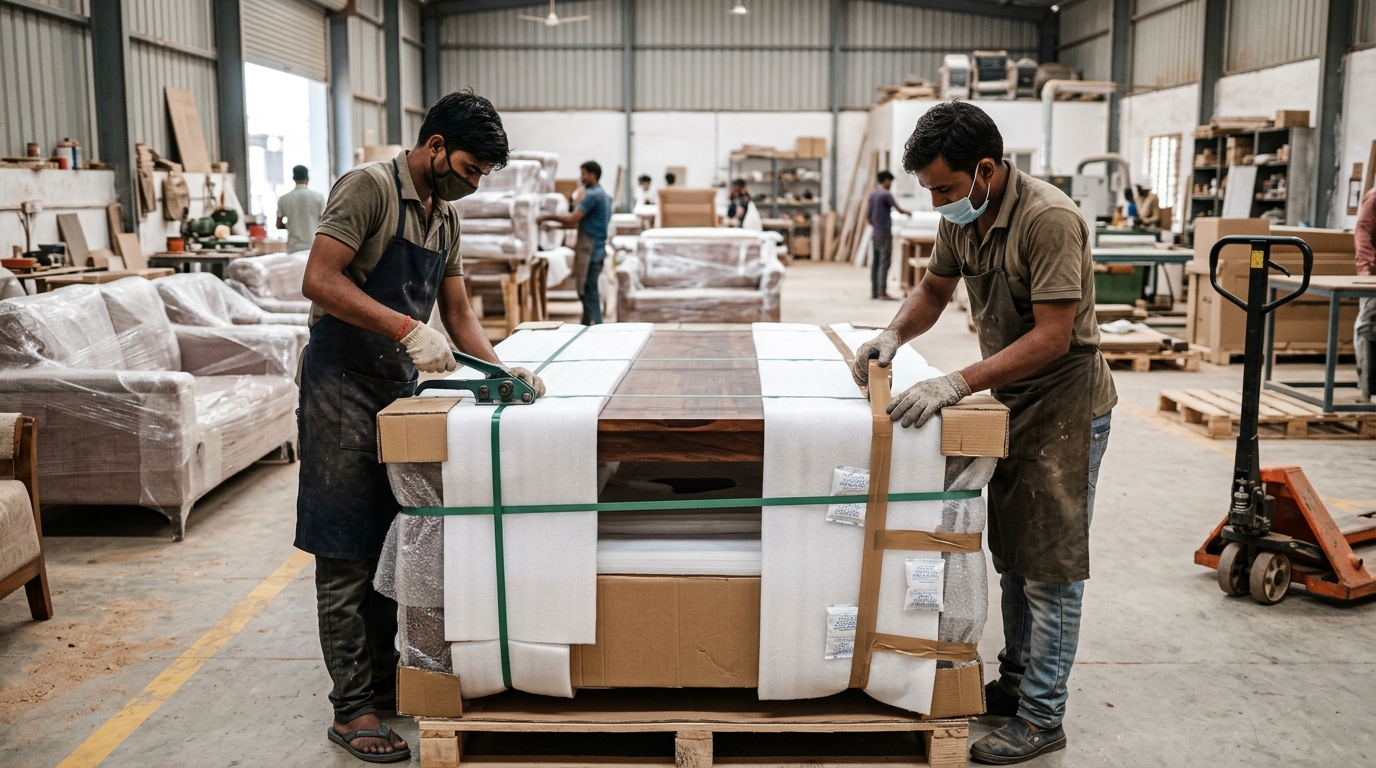
- Ban Airtight Polythene Wrapping: Cheap workshops often wrap wooden tabletops tightly in shrink-wrap plastic. When wood warms up, trapped moisture cannot escape, condensing under the plastic and clouding the lacquer finish. Instead, specify breathable EPE foam sheeting or non-woven fabric.
- Specify Calcium Chloride Hanging Bags: Standard 5g silica gel packets thrown into a carton are useless in an ocean container. Insist on high-capacity calcium chloride container desiccant poles (such as Absortech or Super Dry) hanging in every container wall groove (typically 10 to 14 poles for a 40ft HC).
2. Knock-Down (KD) Engineering vs. Fully Assembled (FA)
Shipping fully assembled dining tables, armchairs, and bed frames burns money on ocean freight. Solid wood furniture has a low weight-to-volume ratio—meaning you hit container volume capacity (CBM) long before reaching maximum payload weight.
Smart buyers engineer their products for Knock-Down (KD) assembly:
| Component Type | Recommended Construction | Packaging Volume Benefit | Hardware Specification |
|---|---|---|---|
| Dining Table Tops & Legs | KD Legs with corner brackets | Reduces boxed height from 78 cm to 14 cm (~70% CBM reduction) | M8/M10 Allen bolts with threaded steel inserts (never direct wood screws). |
| Dining Chairs | Semi-KD or 2-in-1 nested master cartons | Doubles chair loading capacity per container | High-tensile dowels and pre-installed hex fittings. |
| Bed Frames | Flat-pack multi-box system (Headboard, rails, slats) | Fits 80+ beds in a 40HC vs. 25 assembled | Heavy gauge steel center-rail support brackets. |
Use our interactive Furniture CBM Calculator to model the exact cubic meter savings between assembled and KD packaging dimensions before approving factory CAD drawings.
3. Packaging Architecture: 7-Ply Cartons & Honeycomb Protectors
A standard Indian domestic 3-ply carton has an edge crush strength that collapses when stacked 4-high in a high cube container. For international export, mandate the following multi-layer packaging architecture:
- Primary Surface Layer: 2mm non-woven poly-sheeting or scratch-proof soft foam directly against polished timber surfaces to stop transit micro-scratches.
- Edge & Corner Protection: High-density L-shaped compressed paper corner boards (minimum 5mm thickness) along all tabletop edges, plus moulded expanded polyethylene (EPE) corner caps on vulnerable table and chair feet.
- Internal Buffering: Minimum 20mm honeycomb board or EPS foam panels lining all four internal carton walls. If the master carton is dropped from 1 meter, the internal furniture piece must not touch the outer carton wall.
- Export Master Carton: Heavy-duty 7-ply (triple wall) corrugated board with virgin kraft outer liner (200+ GSM) and moisture-resistant adhesive. Bursting strength must exceed 16 kg/cm².
- Reinforced Strapping: Minimum two cross-directional polypropylene (PP) plastic tension straps over outer carton corners to reinforce carton integrity during hand-loading.
4. Container Loading Supervision Checklist
Even the finest export packaging fails if Indian warehouse laborers pack containers carelessly. During our Container Loading Inspections in Jodhpur, our inspectors enforce three non-negotiables:
- Weight Distribution: Heavy solid credenzas and dining table packages must form the bottom tier. Light chairs and boxed mirrors sit on the upper tier.
- Tightly Keyed Stacking: Eliminating voids between cartons. Loose packages slide during maritime vessel pitching, creating a domino crush. Empty gaps must be filled with heavy-duty kraft dunnage air bags.
- Moisture Desiccant Pole Verification: Checking expiration dates and secure mounting of container desiccant poles along internal corrugations.
Protect Your Indian Furniture Containers
Don't let damaged furniture eat into your retail margins. QualityLink Global inspects packaging materials on-site, oversees factory drop tests, and supervises container stuffing in Rajasthan. Book a Pre-Shipment Packaging Inspection →