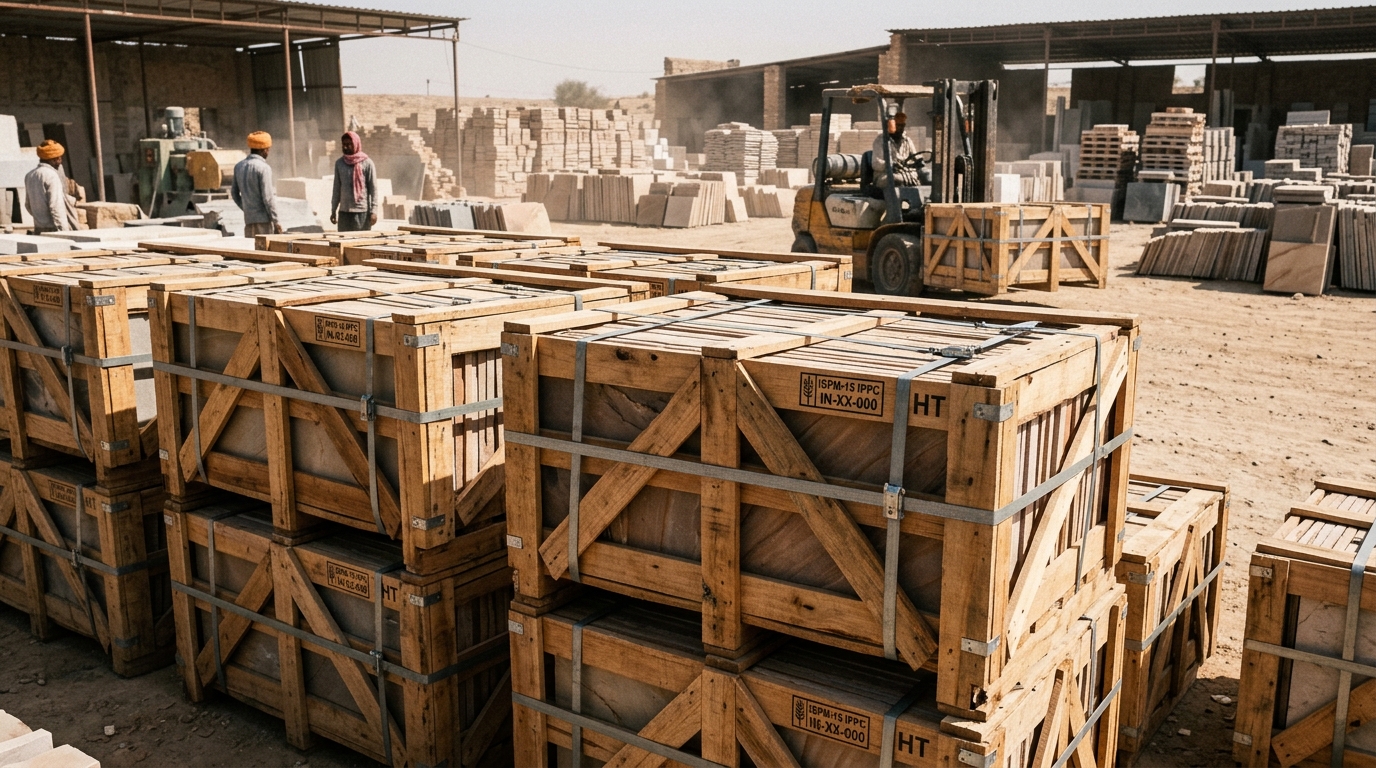
Rajasthan is the global heartland of architectural stone, exporting millions of square meters of Kandla Grey sandstone, Autumn Brown paving, Kishangarh marble, and Makrana architectural elements each year to the UK, Europe, Australia, and North America.
Yet stone is uniquely demanding cargo. It is exceptionally dense, heavy, and brittle under lateral impact. A sudden maritime swell or sharp container shunting at a railway freight terminal can shatter an improperly crated 25-ton container load into jagged scrap, or worse, cause wooden crates to burst open inside the container, posing severe life-safety hazards to port forklift operators.
To import Indian stone safely, commercial landscape contractors, tile distributors, and architectural stone importers must insist on strict crate engineering, phytosanitary treatment compliance, and container weight balance.
1. ISPM-15 Phytosanitary Regulations: The Wheat Stamp Rule
International Standards for Phytosanitary Measures No. 15 (ISPM-15) is strictly enforced by customs border authorities across Europe, North America, Oceania, and Asia to prevent the cross-border introduction of invasive wood-boring pests (such as the Asian Longhorned Beetle).
Every wooden crate, pallet, and piece of wooden bracing used to export stone from India must meet two mandatory conditions:
- Certified Treatment: Timber must undergo Heat Treatment (HT) in an authorized chamber until the wood core reaches a minimum of 56°C for at least 30 continuous minutes.
- Legible IPPC Markings: Both long sides of every wooden crate must feature the official IPPC "wheat stamp" burned or indelibly stamped with waterproof ink:
IN(Country Code for India)XX(Two-digit State Code, e.g., Rajasthan)YYY(Unique registered treatment facility registration number)HT(Heat Treatment) orMB(Methyl Bromide)
2. Wooden Crate Construction Standards for Sawn & Paving Stone
Never accept cheap "nail-jointed" domestic timber crates made of soft pop-lar wood. For heavy paving slabs and architectural tiles, insist on heavy-duty wooden crate engineering:
| Crate Component | Required Specification | Engineering Purpose |
|---|---|---|
| Base Runners (Skids) | Hardwood blocks, min 75mm x 75mm cross-section | Provides clearance for 2.5-ton forklift tines without cracking bottom crate boards. |
| Side Planks & Uprights | Kiln-dried seasoned pine or hardwood, min 18mm–22mm thickness | Resists outward bowing pressure exerted by vertically stacked paving stones. |
| Internal Lining | Polythene moisture barrier sheet + 10mm high-density foam | Prevents rainwater penetration and cushions stone edges against timber abrasion. |
| Tension Strapping | Heavy-gauge high-tensile steel straps or 19mm PET composite straps (min 4 bands) | Binds the entire crate into a rigid single structural unit that withstands crane hoisting. |
3. Slab Stacking: Vertical A-Frames vs. Flat Wooden Crates
The orientation of stone during transport determines its breakage rate:
- Paving Slabs & Tiles (up to 900x600mm): Packed tightly on edge (vertically), with corrugated cardboard separators between individual tiles. Packing stone slabs flat horizontally causes bottom slabs to fracture under transit road vibrations.
- Large Gangsaw Marble & Granite Slabs (2500x1500mm+): Must be transported on heavy steel or wooden A-Frames secured to the container floor. Slabs must be placed polished-face to polished-face with plastic interleaving film, clamped with steel tension rods and timber wedges to prevent sway.
4. Container Weight Distribution & Axle Limits
Natural stone is an ultra-dense commodity. A standard 20ft container of Indian sandstone will hit weight limits before it is even half-full by volume.
Key weight management parameters:
- Gross Payload Balance: A heavy-tested 20ft container can carry up to 27,500 kg to 28,000 kg of stone in India. Never load a 40ft container with solid stone, as it will drastically exceed maximum gross mass (VGM) limits.
- Crate Placement & Center of Gravity: Heavy crates must be symmetrically arranged along the centerline of the container floor — the exact count depends on crate size. Crates packed heavier on one side create a vessel listing hazard or cause truck rollovers during road haulage.
- Timber Bracing & Chocking: Heavy wooden 4x4 timber wedges and floor chocks must be securely nailed into the container's wooden floorboards to prevent crates from shifting longitudinally during emergency vessel braking.
Before confirming your order, calculate exact square meters and tonnage using our free Stone Area Calculator and Stone Weight Tool to ensure your shipment complies with international weight and freight limits.
On-Site Stone Crate & Loading Supervision in Rajasthan
Our stone quality engineers inspect quarries, slab processing lines, and export packing yards across Kota, Kishangarh, Jodhpur, and Bijolia. We verify crate dimensions, ISPM-15 markings, slab calibration, and container weight balance before sealing. Schedule an On-Site Stone Inspection →