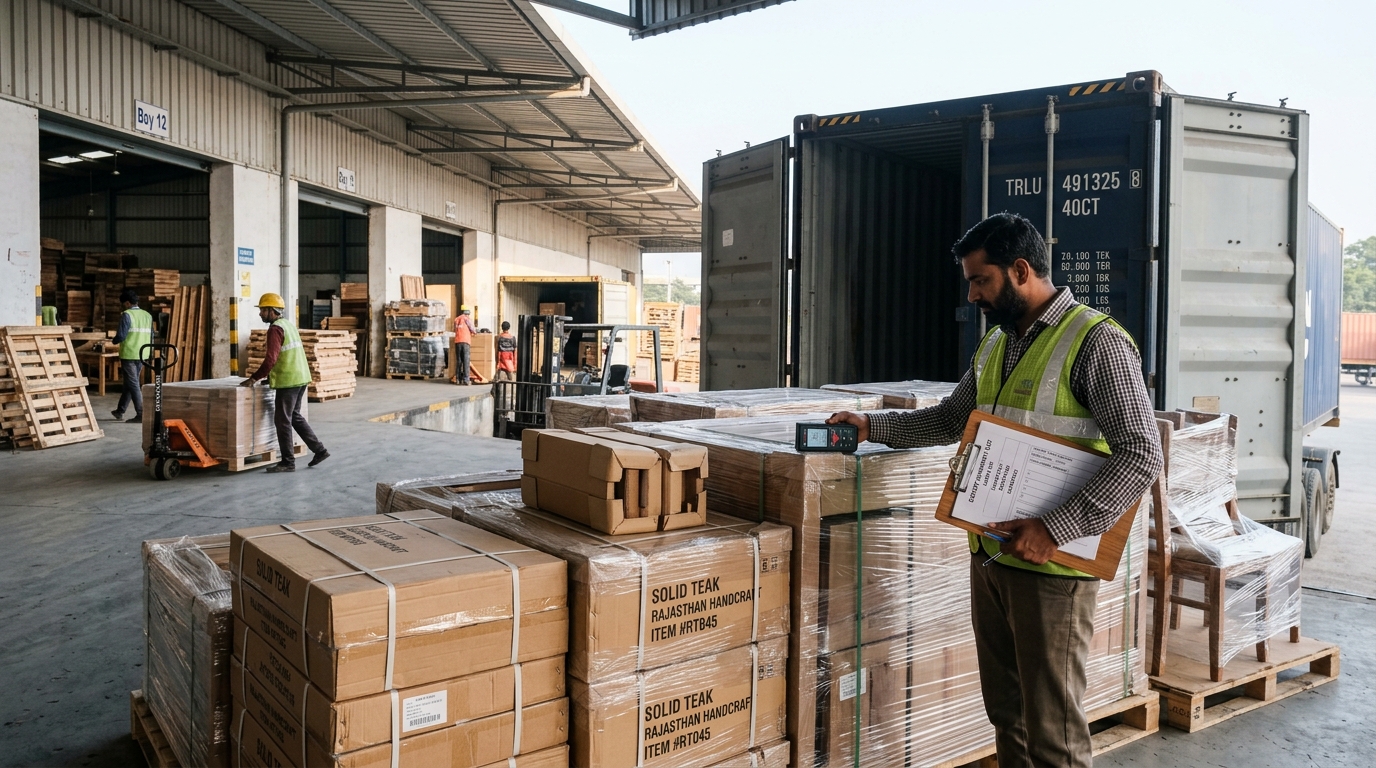
Ocean freight is often one of the largest single cost components when importing solid wood furniture from Jodhpur, Jaipur, or Saharanpur. With international container shipping rates fluctuating, paying to ship "empty air" inside a 40-foot container directly erodes your gross profit margin.
Yet, many first-time furniture importers make container volume calculations based on raw product dimensions taken from factory price lists. When the shipment is packed into 5-ply corrugated export cartons with dense corner foam blocks, they are shocked to discover that 15 cubic meters of their order cannot fit into the container and must be left behind on the factory floor as costly LCL back-orders.
Here is a practical guide to calculating cubic meter (CBM) volume, understanding Knock-Down (KD) vs. fully assembled space ratios, nesting complementary product lines, and managing road and ocean weight limits for Indian solid wood furniture.
1. The Mathematics of Ocean Container Capacity
International shipping lines advertise nominal internal volumes for ISO freight containers. However, in physical furniture loading, rigid rectangular boxes can never pack with 100% volumetric efficiency. There are always voids caused by door clearances, ceiling corrugations, and pallet heights.
| Container Type | Nominal Internal CBM | Realistic Usable CBM (Furniture) | Max Cargo Weight Limit |
|---|---|---|---|
| 20ft Standard (20GP) | 33.2 CBM | 26 – 28 CBM | 21,500 – 24,000 kg |
| 40ft Standard (40GP) | 67.7 CBM | 56 – 58 CBM | 26,500 kg |
| 40ft High Cube (40HQ) | 76.4 CBM | 66 – 68 CBM | 26,500 kg |
Key Takeaway: For Indian furniture imports, always book a 40ft High Cube (40HQ) whenever your volume permits. A 40HQ provides 30cm (12 inches) of additional internal height compared to a standard 40GP for only a minimal freight price difference (the exact gap varies; get quotes), giving you roughly 10 additional cubic meters of packing space—enough to hold 40 to 60 additional dining chairs or small accent tables.
2. How to Calculate Individual Package CBM Correctly
The standard formula for calculating packaging volume is:
For example, a dining chair carton measuring 65cm (L) × 55cm (W) × 95cm (H):
The 15% Packaging Inflation Factor
Never calculate CBM using the bare furniture piece dimensions. When an Indian exporter packs solid wood furniture for maritime transit:
- Heavy 5-ply or 7-ply corrugated outer board adds 15–20mm to each dimension.
- High-density EPE foam corner blocks and side bumpers add 25–40mm on each side.
- Cardboard bulge: When heavy Sheesham chairs or tables are stacked inside containers, carton sidewalls flex outward slightly, adding 10–20mm per carton.
As an operational rule of thumb, always add an extra 12% to 15% to bare product volume when creating an initial procurement purchase order.
3. Knock-Down (KD) vs. Fully Assembled (Semi-KD) Trade-offs
One of the most consequential decisions when developing furniture designs in Jodhpur is deciding which elements should be designed as Knock-Down (KD) and which should remain fully assembled:
Dining Tables and Desks
A fully assembled dining table with welded or fixed legs measuring 200cm × 100cm × 78cm occupies 1.56 CBM. Packed in a 40HQ container, you could fit fewer than 42 tables total—wasting enormous amounts of empty void space beneath the tabletop.
When re-engineered as KD (where legs detach and bolt into structural steel corner brackets under the tabletop), the carton dimensions collapse to 208cm × 108cm × 18cm = 0.404 CBM. You can now pack 140+ dining tables into the exact same container, slashing your per-unit ocean freight cost by over 70%.
Chairs and Barstools
Solid wood dining chairs with rigid tenon joinery are difficult to make KD without compromising structural durability. However, smart factories pack dining chairs in pairs using an interlocking nested configuration (one upright, one inverted), with thick non-scratch EPE foam sheets protecting the touching surfaces. Two chairs packed nested into a single carton typically measure 0.38 CBM (0.19 CBM per chair), compared to 0.32 CBM if boxed individually.
4. Product Nesting: The Secret to High-Margin Consolidation
The most profitable furniture importers rarely ship containers consisting exclusively of large, boxy, low-density pieces. Instead, they engineer complementary product mixes:
- The Heavy Foundation (Base Layer): Heavy items like solid Sheesham credenzas, 3-door sideboards, and architectural chests form the floor layer of the container. These provide solid, flat surfaces for stacking.
- The Intermediate Layer: Medium KD dining tables, flat-packed bed frames, and nested boxed chairs sit securely on top of the case goods.
- The Void Fillers (Top Layer & Cavities): Accent pieces—such as nested sets of 3 side tables, hand-carved decorative boxes, brass lanterns from Moradabad, and rolled jute dhurries—are loaded into the upper 40cm of the container or tucked into drawer cavities.
Plan Your Container Mix Before Issuing Purchase Orders
Use our specialized furniture CBM calculation tool to model how your dining tables, sideboards, and chairs will fit inside 20GP, 40GP, and 40HQ containers.
5. Managing Density: When Solid Wood Containers "Weigh Out"
While lightweight rattan or hollow aluminum furniture will "cube out" (run out of physical volume) long before reaching container weight limits, Indian solid hardwoods are extremely dense:
- Sheesham (Indian Rosewood / Dalbergia sissoo): ~750 to 850 kg/m³ air-dry density.
- Acacia (Babool / Acacia nilotica): ~780 to 880 kg/m³ density.
- Mango Wood (Mangifera indica): ~550 to 650 kg/m³ density.
A 40HQ container has a maximum gross payload allowance of approximately 26,500 kg (subject to local road axle limits in destination countries, which in the US often restricts container cargo weight to ~19,500 kg unless tri-axle chassis are utilized).
If you pack 68 CBM of pure solid Sheesham dining tables and heavy buffets, your net cargo weight could exceed 28,000 kg—triggering heavy overweight road penalties, demurrage fines, or refusal by shipping lines at the ICD (Inland Container Depot). Always balance heavy Sheesham collections with lighter Mango wood or hollow accent pieces to stay safely below destination road limits.
6. On-Site Container Loading Supervision (CLS) Checklist
Even the most perfect loading plan can be ruined on the loading dock if factory laborers load boxes randomly. A professional container loading inspection ensures:
- Container Pre-Check: Verification that the shipping line container has no pinhole roof leaks (light test), no chemical odors, and clean, dry marine-grade flooring.
- Weight Distribution: Ensuring weight is balanced evenly across left and right sides and front-to-back axles to prevent container rollover hazards.
- Tight Blocking & Airbags: Installing heavy-duty inflatable dunnage airbags into centerline voids to prevent load shifting during sea pitch and roll.
- Moisture Desiccant Placement: Hanging high-absorption calcium chloride desiccant poles (not small floor pouches) along the container sidewalls.
- High-Security Bolt Seal: Photographing and recording the customs bolt seal number locked into place immediately upon completion.
Summary
Professional container planning transforms ocean freight from an unpredictable expense into a competitive margin advantage. By booking 40HQ equipment, factoring in packaging allowances, engineering KD table assemblies, nesting chairs, and monitoring container weight limits, you maximize every cubic meter shipped from Rajasthan.